
- All
- Product Name
- Product Keyword
- Product Model
- Product Summary
- Product Description
- Multi Field Search
Please Choose Your Language

Views: 0 Author: Site Editor Publish Time: 2026-07-29 Origin: Site


A failing crimp isn't just a poor connection. It represents a critical point of failure in any electrical system. Faulty terminations cause severe voltage drops, dangerous thermal events, and unpredictable system downtime.
We are observing a massive operational shift across professional and industrial settings. Technicians rapidly move away from manual mechanical tools. They now rely heavily on automated systems to ensure repeatable, gas-tight connections every single time.
This guide offers an objective, evidence-based framework for evaluating your next battery crimping tool. We will strictly focus on tonnage ratings, die precision, and lifecycle reliability. You will learn exactly how to match tool capabilities to your specific wire gauge demands. These core metrics will guide your final purchasing decisions and keep your installations fully compliant.
Precision over Power: High tonnage alone does not guarantee a compliant crimp; matching the tool, die, and terminal profile is the actual metric of success.
Ergonomics equal Consistency: Fatigue reduction directly correlates with lower failure rates in high-volume terminations.
Lifecycle Costs: Upfront pricing is secondary to calibration intervals, die durability, and battery ecosystem compatibility.
Standardization: Tools handling up to 400mm² must meet stringent industry certifications (e.g., UL, IEC) to ensure liability protection.
Understanding the physics of a bad crimp reveals why tool selection matters deeply. A poor termination leaves microscopic air gaps between the wire strands and the connector barrel. Moisture easily enters these gaps. Oxidation immediately follows. This chemical reaction sharply increases electrical resistance across the joint.
Increased resistance generates localized heat during high-load operations. We call this micro-arcing. Heat melts insulation and frequently triggers thermal runaway. The business costs compound rapidly. You face expensive rework, heavy warranty claims, and severe fire hazards.
Compliance adds another layer of strict liability. Professional bodies like the National Electrical Code (NEC) and the International Electrotechnical Commission (IEC) enforce rigid standards. Uncalibrated or mismatched tools fail to meet these electrical code requirements. Inspectors routinely reject installations if connections show inconsistent compression depths.
You must also evaluate your project volume against your current tool class. High labor hours expose the weaknesses of manual operations. Operator fatigue causes defect rates to spike late in the shift. Mathematical necessity dictates an upgrade. When defect rates rise alongside labor hours, automated tools become mandatory for operational survival.
Manual crimpers work adequately for low-volume tasks. You generally use them for low-gauge (AWG) applications in residential or light commercial wiring. They remain portable and simple to operate for quick repairs.
However, their limitations become glaringly obvious during heavy usage. Manual tools deliver highly inconsistent force application. The final compression depends entirely on operator strength. User fatigue sets in quickly. Furthermore, manual ratcheting designs prove completely unsuitable for heavy-duty industrial cables.
Modern automated options solve the fatigue problem entirely. A reliable battery hydraulic crimping tool provides consistent, measured tonnage regardless of operator strength. The internal pump handles the mechanical burden.
These advanced tools feature automatic retraction once they reach maximum pressure. They also offer pressure verification protocols. You hear a distinct click or see an LED indicator confirming full compression.
Implementation realities do require some workflow adjustments. Operators must adhere to strict battery charging protocols. Technicians also need to schedule routine hydraulic maintenance to prevent fluid degradation.
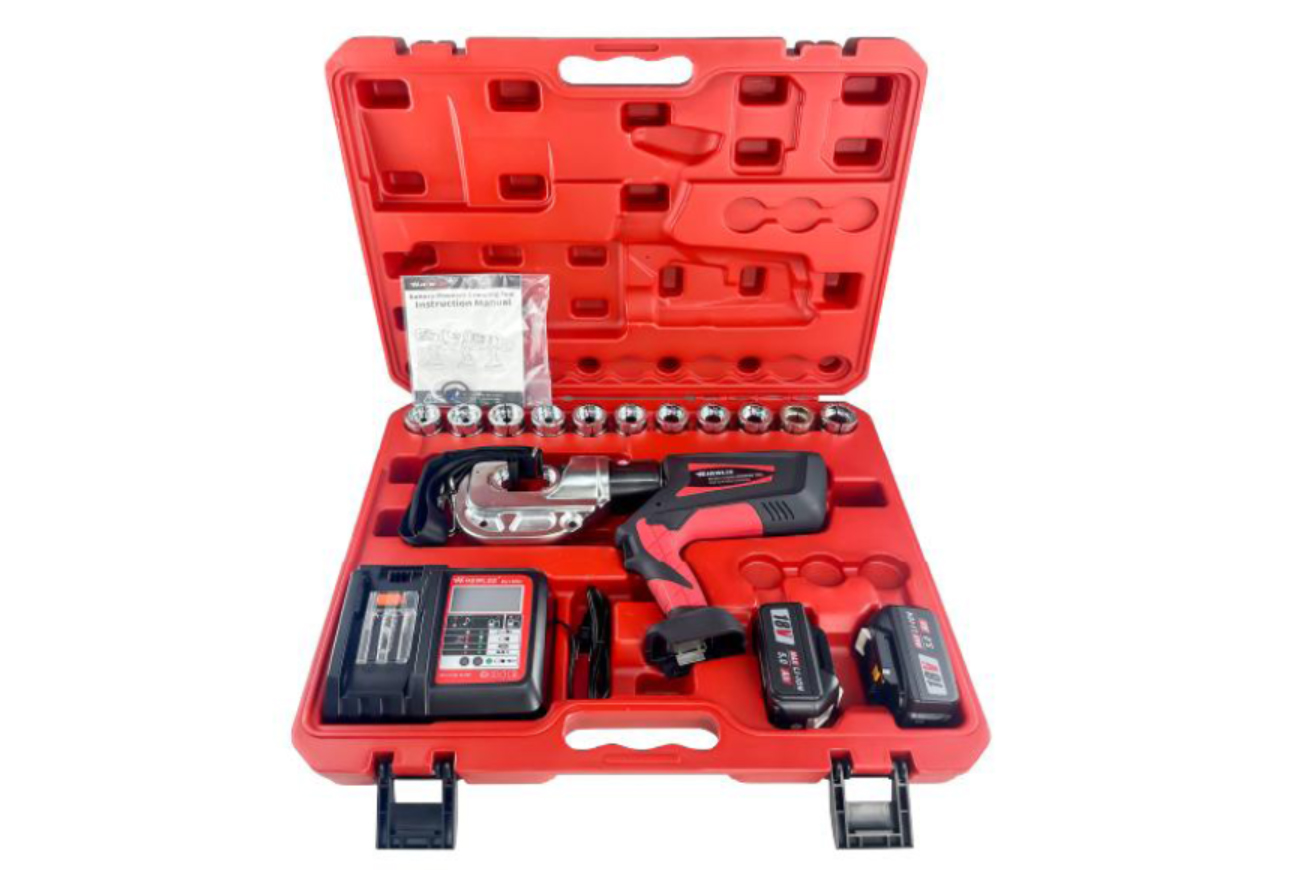
Your first technical evaluation must address required output force. Standard tools typically offer either 6-ton or 12-ton pressure outputs. A 6-ton unit easily manages standard commercial wiring up to roughly 300 MCM.
Heavy industrial projects demand higher capacity limits. Utility-scale solar farms, substation build-outs, and EV infrastructure require massive cables. You absolutely need a dedicated 400mm² crimper to handle these dense copper and aluminum profiles effectively. Insufficient tonnage leaves heavy gauge connectors dangerously under-compressed.
Tool performance relies heavily on the dies. You generally choose between Hexagonal (Hex) dies and Indent dies. Hex dies apply even pressure across six points. Indent dies drive a deep point into the barrel for specific solid-strand applications.
Expertise requires strict adherence to manufacturer pairings. You face severe danger if you mix generic dies with proprietary lugs. A professional cable lug crimping tool demands incredibly tight die tolerances. Loose tolerances cause over-crimping, which pushes excess metal out as sharp "flash." Poorly machined dies also cause under-crimping, leaving dangerous gaps.
Speed dictates daily output. Assess the crimp cycle speed carefully. Top-tier tools complete a full compression cycle in 3 to 6 seconds. Slower tools drain productivity when you face hundreds of terminations.
Evaluate the viability of the battery platform as well. Check if the tools use proprietary batteries or standard 18V/20V systems. Compatibility with existing job site power tools reduces battery clutter and keeps crews working efficiently.
We can summarize the technical differences between tool classes below:
Feature | Manual Ratcheting | Battery Hydraulic (12-Ton) |
|---|---|---|
Force Output | Variable (Operator dependent) | Consistent 120KN (12-ton) |
Fatigue Factor | High (Repetitive strain) | Minimal (Trigger operation) |
Max Wire Gauge | Typically limits at 4/0 AWG | Handles up to 400mm² |
Cycle Speed | Slow (Multiple ratchets) | Fast (3 to 6 seconds) |
Data Logging | None | Available via Bluetooth |
Certain equipment benchmarks the industry standard for high-capacity work. The EC-400B crimping tool serves as a prime example in the 16mm² to 400mm² range. Professionals choose this class because it balances portability with massive force generation.
We must look closely at its performance metrics. This class delivers a standard 120KN (12-ton) output. The stroke length typically measures around 42mm. This generous stroke accommodates thicker splice connectors easily. It also features a rotary head. This flexibility proves essential when working inside confined trenches or tight switchgear boxes.
Target applications for this tool class include high-voltage panel building and heavy equipment wiring. Utility-scale solar and wind installations rely heavily on this precise specification. Crews can terminate massive collector cables without hauling heavy secondary pump hoses across the dirt.
You must validate a few assumptions before procurement. Verify the exact die sets included in the kit. Some ship with AWG standards, while others use Metric profiles. Always ensure the availability of local service centers for your chosen brand. Hydraulic tools require timely servicing.
Even the most advanced hydraulic systems present implementation risks. You must maintain hydraulic integrity to protect your investment. Common failure points include seal degradation. Extreme temperature shifts cause O-rings to harden and crack. Oil leaks follow shortly after.
Debris entering the pump mechanism ruins internal valves. Technicians must clean the tool head daily. Dirt mixed with hydraulic fluid creates a highly abrasive paste.
Calibration schedules demand strict adherence. You should mandate annual calibration for all heavy-duty crimpers. High-volume teams might need calibration every 10,000 cycles. This process maintains tool certification. It ensures the hydraulic relief valve triggers at the exact correct pressure. Missing this schedule voids your compliance guarantees.
Modern site management requires robust software and reporting. Evaluate tools offering Bluetooth connectivity and diagnostic software. These smart features log individual crimp data. They record pressure curves and total cycle counts. This capability provides instant QA documentation and protects your firm during compliance audit trails.
Here are common mistakes to avoid during implementation:
Ignoring the manufacturer's specified calibration intervals.
Storing hydraulic tools in freezing temperatures without thermal protection.
Using cracked or deformed dies to finish a shift.
Failing to log pressure curve data on critical high-voltage joints.
You need a logical framework to finalize your tool selection. Use a straightforward decision matrix to narrow down the options based on daily reality.
If your team handles low volume but a high mix of connector types, prioritize versatility. Look for tools offering easily interchangeable die systems. You want rapid changeovers without requiring specialized keys.
If your projects involve high volume and heavy gauge cables, prioritize sheer capability. You need 12-ton battery hydraulics. Fast cycle times become the most critical metric. Local calibration support ranks equally high, as downtime kills project timelines.
Take these actionable next steps to secure the right equipment:
Request an on-site demonstration using your thickest cable profiles.
Verify terminal-to-die compatibility charts directly with your specific connector manufacturer.
Review the warranty terms specifically covering the internal hydraulic pump and electronic sensors.
Audit your existing battery inventory to check cross-compatibility.
A: No. You must match die profiling exactly. While "U-dies" represent an industry standard shape, mixing brands voids UL listings on the connector. You can only mix them if the manufacturer explicitly cross-certifies the specific combination. Using generic dies leads to dangerous over-crimping or loose connections.
A: Battery life depends entirely on the wire gauge and tool tonnage. Generally, a standard 4.0Ah battery provides 100 to 150 full crimps on heavy gauge copper. Extreme cold weather will slightly reduce this total cycle count.
A: The primary difference involves maximum capacity limits. A 6-ton unit generally handles commercial wiring up to 300 MCM (150mm²). A 12-ton unit handles heavy-duty applications up to 400mm² or larger. It provides the necessary compressive force for dense industrial cables.
A: Look for clear visual indicators first. A good crimp shows no metal flash and leaves a visible die stamp clearly pressed into the lug. Modern smart tools also provide internal diagnostics. Listen for the audible bypass click and watch for the green LED indicator signaling full pressure.


