
- All
- Product Name
- Product Keyword
- Product Model
- Product Summary
- Product Description
- Multi Field Search
Please Choose Your Language

Views: 0 Author: Site Editor Publish Time: 2026-07-31 Origin: Site


Cutting large-diameter electrical cables manually causes severe hand fatigue. Standard hand tools easily mash cable profiles. This distortion directly leads to poor lug terminations. You need better leverage for consistent results. The industry relies heavily on specialized mechanical shears for these exact challenges. They provide clean, low-effort cuts on extremely thick cables. We will explore a strict, specification-driven framework for selecting the right tool. You will learn to choose based on exact outer diameter limits and conductor materials. Properly sizing your equipment ensures OSHA compliance, operator safety, and long tool life. Evaluate your daily use case objectively. Matching physical constraints to mechanical capabilities prevents both broken blades and operator injuries.
Tool selection must prioritize the actual outer diameter of the cable (including insulation), not just the wire gauge (AWG/MCM).
A dedicated copper aluminum cable cutter will suffer catastrophic blade failure if used on steel-reinforced cables (ACSR).
Choosing between a 60mm cable cutter and an 80mm cable cutter dictates whether the tool requires one-handed operation or a two-handed, high-leverage stance.
Quality evaluation hinges on blade geometry, gear tooth durability, and the presence of a quick-release safety mechanism.
Traditional shear-style cutters fail frequently on cables exceeding 1 inch (25mm). Manual loppers demand massive upper body strength. They often crush the internal conductors before finally severing the jacket. Distorted conductors complicate splicing. Crushed wires refuse to fit properly inside standard termination lugs. Operators waste valuable time reshaping mashed wire ends.
Mechanical step-action tools solve this exact operational bottleneck. You squeeze the handles repeatedly using low force. The internal gear mechanism advances the cutting blade one tooth per squeeze. This design converts low input energy into massive shearing pressure. We strongly recommend upgrading to a ratcheting cable cutter to protect operators. This mechanical advantage drastically mitigates Repetitive Strain Injury (RSI) risks. Electricians avoid severe wrist and shoulder damage.
A successful procurement decision delivers immediate operational benefits. You achieve perfectly flat, distortion-free cuts every single time. Workplace hand injuries drop to zero. Furthermore, you gain a robust tool lifespan ensuring maximum operational readiness. Upgrading makes daily installations faster and significantly safer for all field personnel.
Observe your team struggling to cut standard service wires.
Track how often technicians complain about wrist pain.
Monitor the time spent reshaping cable ends for terminations.
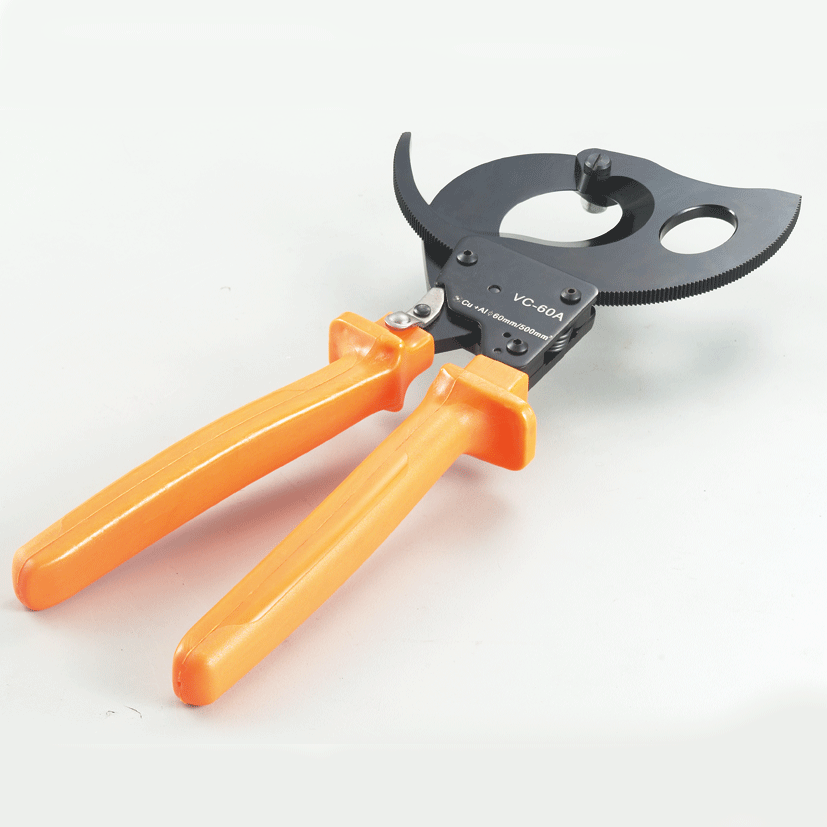
Many professionals mistakenly size their tools based purely on wire gauge. You must remember outer diameter (OD) matters far more than standard copper cross-sections. Insulation thickness varies wildly across different applications. Cross-linked polyethylene (XLPE) jackets measure much thicker than standard PVC covers. A 500 MCM wire featuring THHN insulation fits easily into a compact tool. The exact same 500 MCM wire utilizing heavy underground jacketing requires a significantly larger jaw opening. Always evaluate tools by maximum outer diameter limits.
Compact models focus entirely on swift, one-handed operation. They fit comfortably inside tight panel enclosures. Electricians use them primarily for residential feeds and light-commercial distribution panels. They weigh very little. You can easily carry them in a standard tool pouch all day.
Mid-to-heavy commercial applications demand higher capacity tools. The 60mm cable cutter perfectly bridges the gap between portability and massive leverage. It usually requires telescopic handles. Operators adopt a two-handed grip for final leverage. They are ideal for shearing thick multi-core distribution cables. This size handles the majority of standard commercial service entrances.
Heavy industrial facilities and utility sectors require extreme mechanical force. A specialized 80mm cable cutter handles massive underground feeds easily. Its design strictly demands two-handed operation. It features incredibly robust gear ratios.
Beware of oversizing your daily carry tools. Using an 80mm capacity tool for simple 30mm tasks adds unnecessary weight. It slows down your workflow considerably. Match your primary tool to the 80th percentile of your daily tasks. Keep the heaviest shears in the truck until truly needed.
Ignoring the jacket thickness when reading wire gauges.
Buying the largest available tool for small residential jobs.
Assuming a compact tool can handle heavily armored cables.
You must respect the golden rule of mechanical shears. A dedicated copper aluminum cable cutter is engineered strictly for soft non-ferrous metals. Tool steel easily slices through these softer materials. The blade edge remains pristine. The gears experience predictable, manageable resistance.
Ignoring material limits creates a dangerous implementation risk. Many operators fall into the ACSR trap. Aluminum Conductor Steel Reinforced (ACSR) wire contains incredibly hard central steel strands. People also attempt cutting steel wire rope or tension guy wires. These materials act like chisels against standard blades.
Cutting steel utilizing standard Cu/Al blades causes catastrophic, immediate blade chipping. The hardened steel instantly destroys the induction-hardened cutting edge. This misuse immediately voids all manufacturer warranties. It also creates dangerous metal shrapnel.
If your environment strictly requires steel cutting, alternative solutions exist. Buyers must explicitly specify ACSR-rated ratcheting cutters. These specialized variants feature distinctively hardened blades. They often utilize different blade geometries to prevent edge rolling. Always verify the manufacturer's exact material ratings before initiating a cut.
Material Compatibility and Tool Selection Chart | |||
Cable Material Type | Standard Ratchet Shear Compatibility | Blade Damage Risk | Recommended Solution |
|---|---|---|---|
Standard Copper Wires | High | None (if within OD limit) | Standard Cu/Al Cutters |
Standard Aluminum Wires | High | None (if within OD limit) | Standard Cu/Al Cutters |
ACSR (Steel Reinforced) | Zero | Severe (Instant Chipping) | Specialized ACSR Cutters |
Steel Guy Wires | Zero | Severe (Total Tool Failure) | Hydraulic or specialized steel cutters |
Evaluating tool quality requires a deep understanding of internal mechanics. You cannot judge these devices solely by outward appearance. High performance relies on strict metallurgical standards. Precision engineering prevents catastrophic mid-cut failures.
Always look for induction-hardened cutting edges. Manufacturers harden the specific edge while keeping the blade body slightly flexible. A proper curved profile aggressively shears the soft metal. It never crushes the internal strands. Clean shearing ensures proper fitment into tight lugs and modern connectors. Dull or incorrectly shaped blades cause dangerous localized heating inside the termination block.
Assess the pawl and internal gear design carefully. High-quality tools utilize sophisticated multi-stage gear drives. They distribute massive physical loads evenly across several steel teeth. This distribution absolutely prevents slipping under maximum load. Cheaply manufactured gears round off quickly. Stripped gears render the entire mechanism useless.
You must verify the presence of a quick-release lever. This is a critical safety compliance feature. Tools occasionally jam on oversized wires. Sometimes an operator accidentally bites into a live circuit. The operator must safely disengage the blade mid-cut. They need to back the jaws out without finishing the mechanical stroke. Tools lacking this safety release trap operators in highly dangerous situations.
Examine the handle grip material carefully. Slip-resistant rubber or textured polymers prevent accidental drops. Heavy tools require excellent balance. The tool's overall weight directly impacts user adoption rates. If a tool feels unnecessarily cumbersome, technicians will leave it behind. Good ergonomics directly increase daily compliance and overall workplace safety.
Selecting the perfect tool requires a systematic approach. Guessing leads directly to broken equipment and wasted time. Follow a standardized shortlisting logic. Match physical reality to mechanical limits.
Step 1: Audit Your Cables
Physically measure the maximum OD of your most common materials. Use digital calipers directly on the outer jackets. Record the thickest cables your team regularly handles. Do not rely entirely on electrical schematics. Schematics often omit outer jacket specifications.
Step 2: Determine Handle Type
Analyze your primary working environments. Decide between one-handed and two-handed models. One-handed models offer incredible speed in tight panels. Two-handed models provide massive leverage for heavy distribution capacity. Choose based on actual workspace constraints.
Step 3: Evaluate Tool Longevity
Cheaply cast metal gears strip rapidly under repeated pressure. You should always prioritize forged steel internal mechanisms. Check the availability of replacement blades before purchasing. Over time, even the best ratchet cable cutter requires fresh cutting edges. Easily swappable blades drastically extend overall tool life. Avoid disposable units lacking replaceable parts.
Actionable Next Step
We highly recommend standardizing your tool kits across the entire fleet. Start by running a field trial. Issue the chosen model to a specific site crew. Gather direct feedback regarding weight and cutting speed. Confirm field acceptance before executing bulk fleet procurement.
Selection Decision Matrix | ||
Criteria | Observation | Actionable Decision |
|---|---|---|
Cable Size | Under 32mm OD | Select compact one-handed tool. |
Cable Size | Between 35mm and 60mm OD | Select two-handed medium capacity tool. |
Internal Metal | Steel strands visible | Select specialized ACSR-rated tool. |
Working Space | Confined trench | Prioritize short or telescopic handles. |
Purchasing the correct mechanical shear requires strict attention to physical details. You must accurately match exact physical constraints to mechanical capabilities. Diameter and internal material composition dictate every successful choice. Prioritizing outer diameter over wire gauge prevents tool jamming. Verifying material compatibility prevents immediate blade destruction.
Overestimating your capacity needs results in carrying a bulky, exceptionally heavy tool. Ignoring material constraints guarantees destroyed blades and voided warranties. Evaluate your specific daily use cases objectively. Measure your cables physically. Audit your typical job site constraints. Standardize your equipment strictly based on measured evidence to ensure long-lasting performance and superior operator safety.
A: No. You must strictly differentiate between soft electrical cables and rigid ferrous materials. These blades are engineered solely for shearing soft copper and aluminum. Attempting to cut steel pipes instantly destroys the cutting edge and voids warranties.
A: Yes, usually with a fine file on the beveled edge only. You should carefully remove minor burrs to restore performance. However, heavily chipped or deeply rolled blades must be fully replaced for safety.
A: Manual tools require one continuous, high-force squeeze to finish a cut. Ratchet models use a gear system. They advance the blade in small, low-effort increments across multiple squeezes. This heavily reduces operator hand fatigue.
A: No. Unless the tool specifically carries a verified VDE/1000V insulation rating, you risk severe shock. Even with insulated tools, standard safety protocols require completely de-energizing the circuit before cutting.


