
- All
- Product Name
- Product Keyword
- Product Model
- Product Summary
- Product Description
- Multi Field Search
Please Choose Your Language

Views: 0 Author: Site Editor Publish Time: 2026-08-07 Origin: Site


Removing a cable jacket seems straightforward until you nick an inner conductor. Damaged shielding leads to latent network failures, dangerous electrical faults, and expensive rework. Technicians often rely on standard utility knives for this task. However, precision and consistency drop sharply after the first few cuts. Transitioning from a basic utility knife to a purpose-built round cable stripper is a fundamental requirement. High-volume and critical installations in telecommunications, low-voltage systems, and industrial power demand exact compliance and efficiency.
Improper stripping techniques compromise the physical integrity of the entire cable run. This guide provides an objective framework for evaluating features and matching tool mechanisms to specific cable types. You will learn how to avoid common durability traps. We also explore the physical mechanics of clean jacket removal. By the end of this article, you will know exactly how to select the right tool for your specific application.
Application Dictates Mechanism: High-volume, repetitive jobs benefit from an automatic wire stripper, while mid-span access requires specialized slitting capabilities.
Precision Over Price: Tools lacking micro-adjustable blade depths increase the risk of conductor damage, negating any upfront cost savings.
Lifecycle Costs: A professional cable stripping tool must be evaluated on the availability, cost, and ease of replacing consumable blades.
Versatility: The ability to switch between ringing (circular cuts) and longitudinal slitting dictates the tool's usefulness across varied jacket materials.
Labor heavily dictates project success in modern electrical and network installations. Terminating cables accounts for a massive portion of on-site labor hours. When technicians use inadequate tools, they inevitably damage inner conductors. This forces them to cut the cable back and start over. We call this process re-termination. The labor cost of re-terminating cables quickly exceeds the price of a premium tool. A single bad strip might take five extra minutes to fix. Multiply that by hundreds of connections, and projects fall drastically behind schedule.
Improper jacket removal also creates severe compliance and reliability issues. High-performance cables, especially Category 6a or fiber optics, rely on strict internal geometries. Squeezing or stretching the jacket during removal alters this geometry. Uneven stripping leaves scored dielectrics or crushed twisted pairs. These invisible damages lead to failed certification tests. Network scanners will flag Near-End Crosstalk (NEXT) or Return Loss failures. In fiber applications, microscopic scratches on buffer tubes invite moisture ingress and signal degradation over time.
To avoid these failures, we must define what a successful strip actually looks like. You should evaluate every cut against strict success criteria. A proper cut guarantees system longevity.
Clean Jacket Separation: The outer sheath pulls away smoothly without requiring excessive tearing or pulling forces.
Zero Scoring: The dielectric layers, foil shields, and inner insulations show absolutely no blade marks.
Perfect Geometry: The remaining cable core retains its original shape without crushing or flattening.
Repeatability: The tool delivers identical results across hundreds of consecutive cuts without requiring constant recalibration.
Different installation scenarios require different mechanical approaches to jacket removal. Understanding how blade mechanisms interact with cable sheathing prevents costly mistakes in the field.
Rotary strippers utilize a blade that spins entirely around the cable. This action creates a circular score line around the jacket. We call this process "ringing." Once scored, you simply flex the cable, and the jacket snaps off cleanly. This mechanism excels in standard terminations where the end of the cable remains fully accessible. It is the go-to method for preparing cables for RJ45 connectors, coaxial fittings, or standard power lugs.
Sometimes you cannot access the end of a cable. You might need to tap into a continuous run inside a junction box. This scenario requires a longitudinal cable slitter. The blade on this tool slices parallel to the cable length. It creates a lengthwise seam. You can then pry the jacket open to access the inner cores without severing them. This mid-span access is crucial in FTTH (Fiber to the Home) deployments. Slitters also work exceptionally well for removing highly rigid, thick jackets where ringing and pulling would require too much physical force.
Tensioning dictates how the tool grips the cable during the cut. You must choose between speed and tactile control.
An automatic wire stripper offers incredible speed. You insert the wire, squeeze the handle, and the tool grips, cuts, and pulls the jacket in one fluid motion. This design shines in high-volume panel building or repetitive bench work. However, automatic tools handle a narrower range of jacket types.
Manual, spring-loaded tools require you to physically spin or pull the device. This manual action provides immediate tactile feedback. If the blade hits an unexpected metallic shield, you feel the resistance instantly and can stop. Manual tools offer superior versatility for complex or unpredictable cable structures.
Comparison Chart: Stripping Mechanisms | |||
Mechanism | Primary Action | Best Use Case | Limitation |
|---|---|---|---|
Rotary / Ringing | Circular scoring around the jacket | End-terminations (RJ45, Coax) | Requires access to the cable end |
Longitudinal Slitting | Lengthwise parallel slice | Mid-span access, rigid jackets | Slower setup time per cut |
Automatic | Single-squeeze grip and strip | High-volume repetitive cuts | Lacks tactile feedback |
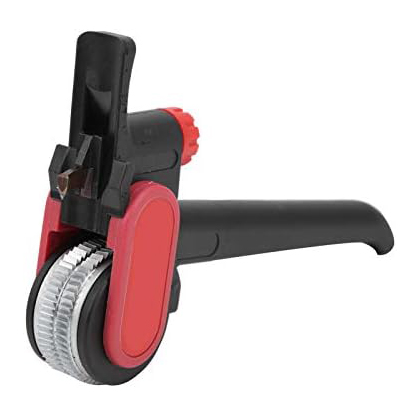
Not all stripping tools perform equally under field conditions. You must evaluate specific physical dimensions before committing to a tool platform.
Jacket thicknesses vary wildly, even within the same cable category. An adjustable cable stripper must feature secure, reliable depth calibration. You need the blade to penetrate exactly 90% of the jacket depth. The remaining 10% tears away manually, ensuring the blade never touches the conductors inside.
Common Mistake: Beware of tools where the adjustment knob drifts. Poorly manufactured dials loosen from the vibration of spinning around the cable. A drifting dial leads to inconsistent cuts. One cable strips perfectly; the next suffers deep conductor gouges. Look for tools featuring locking set-screws or ratcheting depth dials that click securely into place.
A tool's capacity dictates its usefulness. Before purchasing, audit your most common cable sizes. Typical low-voltage tools handle diameters from 4.5mm to 29mm. Buying a tool with too narrow a capacity forces you to carry multiple devices. Conversely, using a massive industrial stripper on delicate 5mm data cables feels clumsy and increases the risk of damage. Match the tool's primary capacity window to 80% of your daily workload.
Blades wear out. It is a physical certainty. Standard steel blades lose their edge quickly against tough LSZH (Low Smoke Zero Halogen) jackets. Upgrading to hardened steel or PTFE-coated blades reduces cutting friction and extends the tool's lifespan significantly.
More importantly, you must assess consumable availability. Buying a cheaper tool often creates an implementation trap. The initial purchase seems economical, but replacement blades prove proprietary, excessively expensive, or constantly backordered. A tool becomes a useless paperweight if you cannot source fresh blades locally or quickly online.
Field environments punish hand tools. You must evaluate the housing materials carefully.
Impact-Resistant Polymers: Lightweight and comfortable in cold environments. Good for data centers and indoor wiring.
Metal Chassis: Heavier, but impervious to drops on concrete. Best for harsh industrial sites.
Consider hand fatigue. High-volume termination phases require hundreds of stripping motions per day. A tool with sharp plastic edges or awkward grip angles causes repetitive strain. Ergonomic, rubberized grips distribute pressure evenly across your palm.
Applying the wrong tool to a specific cable guarantees failure. Different environments demand distinct features from your cable stripping tool. Here is how to match them effectively.
Data cables feature delicate internal structures. Cat6 cables utilize spline separators and tightly twisted pairs to prevent crosstalk. Coaxial cables rely on a thin braided shield just beneath the jacket. Stripping these requires lightweight tools with highly sensitive depth control. If your blade nicks the coax braid, signal leakage occurs. You need a tool that allows micro-millimeter depth adjustments. Spring tension should remain relatively light to prevent crushing the cable core during rotation.
Fiber optics demand zero-tolerance precision. A single scratch on a glass strand destroys the link. Fiber cables often feature rigid outer jackets and internal buffer tubes. You cannot use standard electrical strippers here. Fiber applications require tools specifically rated for buffer tube slitting. These tools use highly calibrated channels. You lay the tube in the specific channel matching its diameter, ensuring the blade depth stops perfectly above the fragile glass fibers inside.
Industrial environments use cables built to survive physical abuse. SOOW cords and thick power lines feature tough, rubberized, and abrasive jackets. Stripping these requires significant mechanical force. Lightweight polymer tools flex and snap under this pressure. You require robust metal chassis designs capable of handling thick jackets. The tool must apply high torque without chassis flex. The blades must also withstand dragging through embedded nylon rip-cords or dense rubber without instantly dulling.
Cable Environment Match Guide | ||
Cable Type | Critical Vulnerability | Required Tool Feature |
|---|---|---|
Cat6 / Data | Twisted pair geometry, foil shields | Micro-adjustable depth, light tension |
Fiber Optic | Glass strands, buffer tubes | Zero-tolerance channels, precision slitting |
SOOW / Heavy Power | Thick, abrasive outer jackets | Metal chassis, high-torque grip |
Even experienced professionals fall for marketing traps. Avoid these specific pitfalls when evaluating your next purchase.
Be highly skeptical of tools claiming to perfectly strip every cable type from thin 24 AWG data lines to heavy 4/0 power cables. Physics prevents this from working well. A spring strong enough to grip a massive power cable will crush a delicate data line. A blade designed to carve thick rubber will clumsily shred thin PVC. Dedicated tools generally outperform multi-tools in professional settings. Build a kit of two or three specialized tools rather than relying on one compromised gadget.
A precision cut requires a rigid blade. Before buying, inspect the blade housing. Any lateral movement or "play" in the blade carrier ruins the cut. When you rotate a wobbly blade around a cable, it does not complete a perfect circle. Instead, it drifts sideways, creating a spiraling cut. This corkscrew effect makes it impossible to snap the jacket off cleanly. It leaves jagged edges that interfere with connector boots. Ensure the blade mechanism locks tightly into its track.
Consider the field reality of tool calibration. Some tools require a separate, tiny hex key to adjust the blade depth. This introduces massive calibration friction. Technicians drop hex keys in the dirt or lose them in crowded tool bags. When adjusting the blade becomes a hassle, technicians simply stop doing it. They will force a miscalibrated tool to work, leading to poor cuts and damaged conductors. Always favor tools featuring tool-less depth adjustment knobs built directly into the chassis.
Choosing the correct stripper directly impacts your installation speed, certification pass rates, and overall project profitability. The shortlisting logic remains straightforward: combine your specific cable diameter, the jacket material toughness, and your daily volume of cuts to determine the correct tool category. A high-volume data project demands rotary precision, while industrial tapping requires heavy-duty longitudinal slitting.
Take action by auditing your current waste and re-termination rates. If technicians frequently redo connections due to nicked wires, a tool upgrade pays for itself immediately. Once you identify the right model, standardize that specific tool across your entire team. Standardization streamlines your replacement blade inventory and simplifies training for new hires. Equip your team with precise, reliable tools, and eliminate the hidden costs of poor cable preparation entirely.
A: Ringing involves spinning the blade around the cable to create a circular score line. This allows you to snap off the end of the jacket for standard terminations. Longitudinal slitting means slicing parallel down the length of the cable. This technique opens a lengthwise seam, allowing mid-span access to internal wires without cutting the main line.
A: Blade lifespan depends entirely on cut volume and jacket material. Standard PVC jackets might allow 1,000 cuts per blade. However, abrasive materials like LSZH or thick industrial rubber can dull a blade in under 200 cuts. Replace the blade immediately when you notice it tearing the jacket rather than slicing it cleanly.
A: No. Round strippers rely on circular geometry to maintain an even blade depth. Flat cables, like Romex, have uneven distances from the jacket surface to the internal conductors. Using a round tool on flat cables will severely gouge the internal wires. Always use dedicated flat-cable tools for those applications.


