
- All
- Product Name
- Product Keyword
- Product Model
- Product Summary
- Product Description
- Multi Field Search
Please Choose Your Language

Views: 0 Author: Site Editor Publish Time: 2026-10-01 Origin: Site


Have you ever carefully clamped down on a piece of Romex, pulled the handles, and realized you just snipped half the copper strands by mistake? We have all been there at some point. It is a universally frustrating moment for both weekend DIY enthusiasts and seasoned field electricians. A clean and pristine strip is absolutely vital for your safety. It also guarantees the long-term optimal conductivity of your entire circuit.
Poor preparation techniques do more than just ruin expensive materials. They actively create hidden electrical hazards behind your walls. In this comprehensive guide, you will learn exactly how to master this essential field skill. We will explore the anatomy of your equipment and cover the most frequent beginner blunders. Finally, we will outline the proper and professional methods required to ensure flawless connections every single time.
Match the Gauge Precisely: The foundational rule of operation is perfectly matching the wire American Wire Gauge, commonly known as AWG, to the corresponding hole on the jaws. This single step prevents scoring or nicking the underlying conductor.
Tool Selection Matters: Automatic models provide incredible efficiency for repetitive tasks. In contrast, manual variants offer the exact precision required for navigating tight electrical boxes and handling delicate electronics.
Technique Over Force: Proper insulation removal relies on a gentle twist and a smooth linear pull. Applying excessive force usually indicates an incorrect gauge selection and inevitably leads to core damage.
Safety First: Damaged conductors create significant electrical resistance. This resistance can lead to overheating, arcing, and electrical fires. If you nick the metal core, standard safety protocols dictate that you must cut the end off and start over.
The electrical hand tool market is currently undergoing a massive transformation. With the rapid explosion of smart home automation and IoT devices, field technicians are now handling thousands of delicate low-voltage connections on a single job site. This unprecedented volume has driven a massive industry shift toward ergonomic and self-adjusting wire stripping tools.
Furthermore, safety regulatory boards are placing a heavier emphasis on preventing repetitive strain injuries among tradespeople. Consequently, modern manufacturers are moving away from basic stamped metal designs. The new standard focuses on precision-ground carbon steel blades and dual-color TPR grips that drastically reduce hand fatigue. Staying updated with these tooling trends not only protects your physical health but also dramatically increases your daily installation speed.
A dedicated stripping instrument is a precision-engineered hand tool designed specifically for removing the protective dielectric jacket from electrical lines. It accomplishes this without altering the conductive core beneath. Unlike standard cutting pliers or heavy-duty utility knives, this instrument utilizes calibrated notches. Understanding its specific anatomy is critical for safe and effective operation.
Located at the very base or the tip of the tool, the cutting jaws act as a standard shear cutter. This robust section is utilized for snipping lines to the appropriate length before the actual stripping process begins. Premium blades are typically forged from high-carbon steel. They are uniquely angled to cleanly slice through both the thick outer plastic and the inner copper core without flattening the profile excessively.
The defining feature of any stripping instrument is the series of graduated AWG sizing holes. These holes are precision-machined to slice exactly through the plastic or rubber jacket. Specifically, they leave a microscopic protective gap above the metal conductor. When you close the handles, the blades sever the jacket, but the circular opening prevents the hardened steel from ever touching the soft copper beneath. Standard industrial models typically cover a working range from 10 to 22 AWG.
A frequent source of confusion on job sites is the dual sets of numbers found on the faceplate of many models. These correspond to solid core and stranded variations. Solid core consists of a single thick piece of metal and is the standard for residential home wiring. Stranded core consists of multiple smaller threads of metal bundled together. This offers the high flexibility needed for automotive and electronic applications.
Because stranded variations have tiny air gaps between the individual threads, a stranded line of a specific gauge is physically slightly larger in diameter than a solid line of the exact same gauge. Therefore, using the correct calibration scale is mandatory to avoid tearing those fragile outer threads.
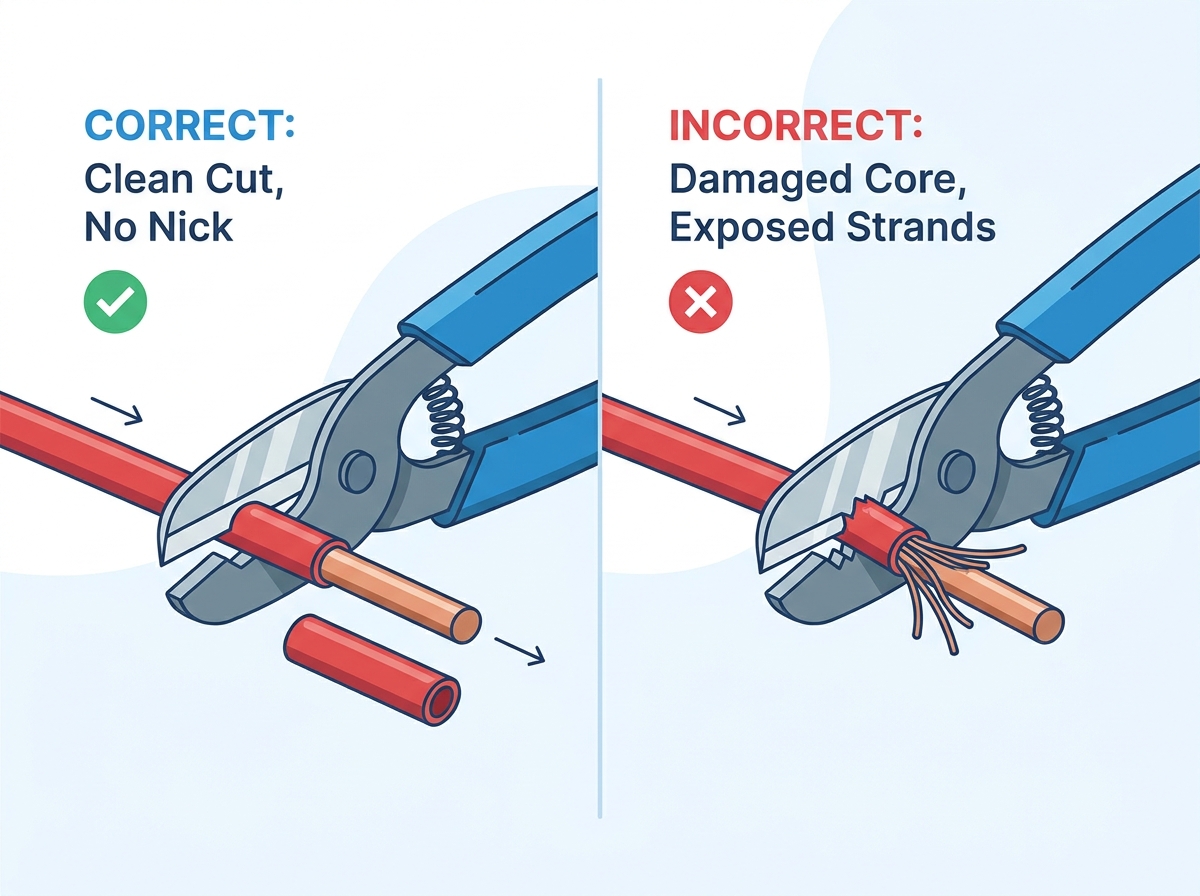
In electrical engineering, precision is not a luxury. It is a strict safety requirement. Damaging the underlying conductor while attempting to remove the insulation is a critical error that compromises the integrity of the entire circuit. The real-world consequences range from frustrating intermittent power losses to severe and life-threatening fire hazards.
When the jaws accidentally cut into a solid copper core, it creates a gouge or a nick. From an engineering standpoint, this reduces the cross-sectional area of the conductor at that specific microscopic point. A reduced cross-section creates a bottleneck for the electrical current, which immediately increases electrical resistance. According to the laws of physics, increased resistance results in increased heat generation. Under heavy electrical loads, this localized heating can degrade the surrounding insulation, melt plastic connectors, and eventually lead to a devastating electrical fire.
For flexible cords, using an overly aggressive technique often results in severing several of the outer copper threads. If a 14 AWG stranded line loses twenty percent of its outer threads during the prep phase, it no longer possesses the safe current-carrying capacity of a 14 AWG line. It effectively becomes a smaller gauge at the termination point. If the circuit draws the maximum current rated for the original size, that specific damaged section will overheat rapidly.
Copper is a highly conductive but relatively soft metal. It is incredibly susceptible to metal fatigue. When a solid core is scored by sharp steel, the nick creates a mechanical stress concentration point. Imagine bending that freshly prepped copper to form a loop for a wall outlet terminal. The metal is highly likely to snap exactly at the point of the nick. This results in wasted material, frustratingly shortened leads inside cramped electrical boxes, and significant project delays.
Observational data from professional electrical communities highlights that the vast majority of material damage stems from a few easily correctable user errors. Recognizing these bad habits is your first step toward achieving professional-grade results.
The most prevalent mistake is simply guessing the size rather than verifying it. If you select a hole that is too small, the blades will aggressively bite into the copper. Conversely, if you select a hole that is too large, the blades will fail to sever the jacket completely. This forces you to yank the plastic off, which stretches and damages the PVC jacket. Always read the printing on the outer jacket. If the printing is worn off, test it in a larger hole first and step down gradually.
In addition, many beginners clamp down hard and then yank the handles sideways at a sharp angle. This improper leverage bends the copper core and tears the plastic unevenly. To fix this, always pull the instrument straight off the axis of the cable. Ensure the plastic slides off as a perfect and unbroken cylinder.
Finally, using dull equipment is a guaranteed way to ruin a connection. A rusted or low-quality pair of jaws does not cut the jacket. It crushes and mashes it. This forces the user to apply excessive hand pressure. To avoid this, invest in a reliable and high-quality wire stripping tool constructed from hardened steel with precision-ground holes.
Using these instruments correctly requires a specific standard operating procedure to guarantee damage-free results every time you reach into your tool pouch. The approach differs slightly depending on the mechanism you choose.
Before picking up any equipment, physically inspect the cable to determine the exact gauge. Open the jaws fully and place the cable into the exact matching hole. Position it so that about half an inch protrudes past the blades. Squeeze the handles together until they close completely. You should feel a slight initial resistance as the blades slice through the soft PVC, followed by a definitive hard stop.
Instead of simply yanking backward, rotate your wrist slightly back and forth. This micro-movement ensures that the jacket is cleanly severed completely around the circumference. Keep the jaws closed and push the frame straight forward with your thumb. The severed slug of plastic will slide smoothly off the end.
Automatic variants are brilliantly designed to remove the variable of human error entirely. They utilize a complex compound mechanism that grips the cable and pulls the jacket off in a single satisfying squeeze. Insert the unstripped end into the front jaws of the device until it hits the built-in depth gauge stopper. Squeeze the handles together in one smooth and continuous motion. The internal mechanism will automatically clamp the jacket on one side, sever the plastic on the other, and pull the two sides apart in a fraction of a second. Release the handles fully before attempting to remove the cable.
Selecting the correct equipment is a critical decision that impacts both the safety of your installations and your overall daily efficiency. Below is a quick diagnostic table to help you match the right design to your specific operational environment.
Tool Type | Best Application Environment | Key Advantages | Limitations |
|---|---|---|---|
Manual Precision | Residential wiring, tight junction boxes | Compact size, high tactile feedback, built-in screw shears | Requires manual gauge selection, slower for bulk tasks |
Self-Adjusting Automatic | Control panels, smart home IoT, automotive | Extreme speed, zero guesswork, prevents RSI | Bulkier head design, struggles in very cramped wall boxes |
Heavy-Duty Multi-Tool | Mobile field service, HVAC repair | Combines pliers, cutters, and crimpers in one chassis | Heavier to carry, slightly less specialized precision |
Regardless of the specific style you choose, manufacturing tolerances are the single most important factor. A dependable tool must feature laser-machined or precision-ground holes. For instance, professional wire stripping equipment often utilizes high-carbon steel with a black oxide finish for supreme rust prevention and lasting blade sharpness.
Preparing electrical lines is a fundamental and non-negotiable skill for anyone working with electricity. It relies entirely on accurately matching the gauge to the instrument and employing a smooth and controlled technique rather than brute force. Practicing on scrap pieces before diving into a live project is a fantastic way to build muscle memory and prevent costly mistakes.
If you find yourself constantly battling jagged insulation or nicked copper cores, it is definitely time to evaluate your current loadout. Stop risking your safety with dull and inaccurate blades. Upgrade your toolkit to industrial-grade standards today. Explore the premium selection of Wire Stripping Tools from FSE to find the exact ergonomic solution that fits your daily workflow. Quality instruments not only make the job exponentially easier but also ensure safe and damage-free electrical connections that will stand the test of time.
If you nick or gouge a solid copper core, or inadvertently cut off strands of a stranded cable, you must cut the line off below the damaged point and start over. A nick in the metal creates a localized point of high electrical resistance. When current flows through this physically restricted area, it generates excess heat. Over time, this heat can degrade the surrounding insulation and potentially lead to arcing or dangerous electrical fires.
While it may be physically possible in an absolute emergency, using a utility knife or scissors is highly discouraged by professional engineers and safety standards. Knives lack the calibrated depth notches found on dedicated equipment. Consequently, the user must rely entirely on tactile feel to determine when the blade has penetrated the plastic but not the metal. This manual estimation is highly unreliable and creates severe hidden safety hazards.
Many professional instruments feature two distinct sets of AWG numbers because solid and stranded cables have different physical dimensions. One side is precisely calibrated for solid core, while the other is calibrated for stranded. Because of the microscopic air gaps between the individual twisted threads, a stranded cable has a slightly larger overall diameter than a solid one of the exact same gauge.
The optimal length of exposed copper depends entirely on the specific application and the terminal type being used. Generally, exposing half an inch to three-quarters of an inch of bare metal is the standard requirement for connecting to standard wall outlets or twisting them into wire nuts. Always use the built-in strip gauge molded into the back of most electrical receptacles to ensure the length matches the manufacturer specifications perfectly.
Absolutely not. You should never attempt to cut or strip an energized circuit under any circumstances. Doing so exposes you to lethal electrical shocks and severe arc flashes. Furthermore, your steel hand tools will immediately cause a dead short if they bridge the hot and neutral lines. Always turn off the power at the main breaker panel and verify the circuit is dead using a reliable non-contact voltage tester before beginning your work.
Wire cutters, often called diagonal cutters or flush cutters, feature solid sharpened blades designed exclusively to slice completely through both the insulation and the metal core in one motion. In contrast, wire strippers have precision-milled circular notches. These notches are mathematically sized to cut only the outer plastic jacket while leaving the inner metal core completely untouched and intact.


