
- All
- Product Name
- Product Keyword
- Product Model
- Product Summary
- Product Description
- Multi Field Search
Please Choose Your Language

Views: 0 Author: Site Editor Publish Time: 2026-08-10 Origin: Site


Transitioning from manual crimping to automated or semi-automated solutions is a critical step for scaling wire harness production. Manual assembly methods struggle to maintain pace as daily order volumes grow. Facilities must find efficient upgrades to stay competitive in modern manufacturing. This is where a pneumatic crimping machine proves invaluable. It utilizes compressed air to actuate precision crimping dies. This technology replaces inconsistent human force with steady, repeatable mechanical pressure. Such consistency is vital for passing strict quality assurance tests.
This guide breaks down how these machines operate on the factory floor. We explore where they fit seamlessly into your existing production line. We also detail the exact technical criteria required to evaluate equipment. You will learn how to shortlist the right unit for your facility. You can optimize cycle times while maintaining strict electrical connectivity standards.
Pneumatic crimping machines bridge the gap between low-volume manual tools and fully automated, high-cost hydraulic systems.
They eliminate operator fatigue and guarantee strict crimp profile consistency, critical for UL or MIL-SPEC compliance.
Proper selection requires matching the machine’s output force (kN) to specific wire gauges—ranging from standard 6mm² setups to heavy-duty 300mm² applications.
Implementation relies heavily on facility infrastructure, specifically stable, clean compressed air (typically 0.5–0.8 MPa) and interchangeable die compatibility.
A pneumatic terminal crimper transforms pressurized air into intense mechanical force. The process begins at your facility's air supply line. Regulated air flows directly into the machine intake. An operator initiates the cycle by pressing a foot pedal or triggering a hand valve. This specific action opens internal pneumatic valves instantly. Pressurized air rushes into a heavy-duty pneumatic cylinder. The sudden influx of air drives an internal piston downward rapidly. The piston connects directly to the crimping die closure mechanism. This motion forces the upper and lower dies together around the wire and terminal. The intense pressure creates a secure, gas-tight electrical connection. Once the cycle finishes, internal springs or reverse airflow retract the piston. The dies open, and the operator removes the finished assembly.
Modern production facilities utilize two primary form factors for air-powered crimping. Each serves distinct operational workflows.
Bench-Mount Pneumatic Machines: These units remain completely stationary on assembly workstations. Operators actuate them using dedicated foot pedals. This setup frees up both hands for faster wire insertion. Bench-mount models deliver incredibly high repeatability during long, demanding shifts. They handle the vast majority of standard harness building.
Handheld Pneumatic Tools: These models offer superior mobility across the factory floor. Technicians carry them directly to complex board assemblies. They navigate easily inside bulky cable harnesses or tight equipment enclosures. Handheld units sacrifice some raw power for ultimate flexibility.
You must understand a fundamental truth about these machines. The machine itself is simply a force-delivery mechanism. True precision lies entirely within the interchangeable die sets. The die profiles must perfectly match your specific terminal type. Common profiles include standard ferrules, insulated ring terminals, and uninsulated quick disconnects. Using generic dies for proprietary terminals guarantees loose connections. You must swap die sets when changing production batches. The upper and lower die halves dictate the exact shape of the finished metal barrel.
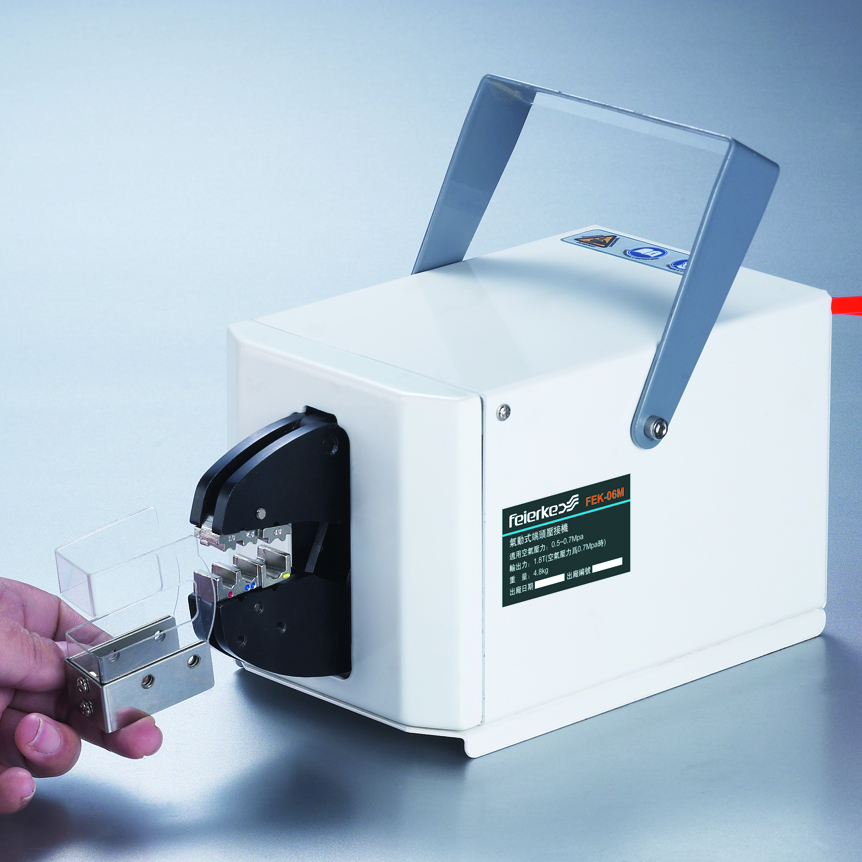
High-mix, medium-to-high-volume environments face serious production bottlenecks daily. Manual hand tools often slow down cycle times severely. They rely entirely on human grip strength. This physical requirement introduces serious ergonomic risks for your assembly team. Repetitive strain injury (RSI) is a common, costly hazard among harness workers. Fatigued operators naturally produce inconsistent crimps by the end of a shift. Under-crimped wires slip out of terminals easily. Over-crimped wires suffer from fractured copper strands. Both scenarios ruin production yields.
Air-powered systems solve these ergonomic and speed issues effectively. They are ideal for mid-range wire sizes where speed is paramount. Pneumatic equipment cycles much faster than standard hydraulic alternatives. Operators can process hundreds of connections per hour effortlessly. You eliminate hand fatigue completely. However, you must acknowledge their lower maximum force output. They easily handle high-volume runs of smaller gauges. If your facility processes standard automotive or appliance wiring, air-driven tools fit perfectly.
Facilities must recognize physical limitations when scaling wire sizes. Standard pneumatics handle sizes up to 16mm² or 50mm² easily. Larger industrial cables demand massive tonnage to deform thick metal lugs. Applications requiring a 300mm² crimping press push far beyond standard air cylinder capabilities. You cannot simply increase air line pressure to solve this. These heavy-duty jobs typically necessitate pneumo-hydraulic systems. These hybrid units use air to drive internal hydraulic fluid, multiplying force exponentially. Pure electro-hydraulic systems also serve this extreme heavy-duty niche well. They achieve the required tonnage without demanding massive factory floor space.
The chart below outlines the key differences between standard assembly methods. Use it to verify your technology choice.
Technology Type | Speed / Cycle Time | Maximum Force Output | Ergonomic Impact | Ideal Production Fit |
|---|---|---|---|---|
Manual Hand Tools | Slow (Manual squeeze) | Low (Operator dependent) | High Risk (RSI fatigue) | Low-volume repair, field service |
Standard Pneumatic | Very Fast (Instant actuation) | Medium (Up to ~50mm²) | Zero Risk (Pedal operated) | Mid-to-high volume, high-mix lines |
Hydraulic / Hybrid | Moderate (Fluid build-up) | Extremely High (Up to 300mm²+) | Zero Risk (Pedal/Button) | Heavy industrial cables, battery lugs |
Selecting the right equipment requires analyzing specific operational metrics carefully. You cannot guess the required mechanical force. Output force is typically measured in tons or kilonewtons (kN). Proper sizing requires matching this output force to your largest wire gauge. A standard 6mm² crimping machine often needs only 1.5 to 2.0 tons of force. This easily deforms small brass or copper barrels. Conversely, larger gauges demand significantly higher kN ratings to displace thick metal properly. Always over-spec your machine slightly. Running a cylinder at absolute maximum capacity reduces its operational lifespan.
Air pressure requirements define basic operational compatibility for any pneumatic tool. Most units assume a steady supply of 70 to 115 PSI. This equates to roughly 0.5 to 0.8 MPa. Your factory must maintain this pressure constantly. Furthermore, an FRL (Filter, Regulator, Lubricator) system is an absolute necessity. You must install one inline before the machine intake. The filter removes damaging moisture and debris from factory air lines. The regulator maintains exact PSI, preventing dangerous pressure spikes. The lubricator mists internal cylinder seals automatically. Skipping the FRL system guarantees premature seal failure and costly downtime.
Assess proprietary versus universal die systems during your evaluation. High-mix manufacturing environments require rapid changeovers between completely different wire batches. Universal die mechanisms allow technicians to swap profiles in mere seconds. They use standardized mounting tracks or quick-release pins. Proprietary die systems might trap you into a single expensive vendor ecosystem. Evaluate the actual changeover time practically. Ask the vendor to demonstrate a die swap on video. Complex bolting systems waste valuable production minutes every single day.
Cycle speed directly influences your hourly throughput metrics. Look closely at the pneumatic actuation speed published by the manufacturer. You must also review the cylinder reset time. A fast downward stroke means nothing if the upward reset lags sluggishly. Optimal machines cycle completely in under one second. This rapid return allows the operator to insert the next wire immediately. Faster cycle speeds lower your overall cost per termination dramatically.
Wire Gauge Size | Typical Terminal Type | Estimated Force Required (Tons) |
|---|---|---|
0.5mm² - 6.0mm² | Standard Insulated / Bare Ferrules | 1.0 - 2.0 Tons |
10mm² - 25mm² | Non-Insulated Tubular Terminals | 2.5 - 4.0 Tons |
35mm² - 50mm² | Heavy Duty Battery Lugs | 5.0 - 6.5 Tons |
120mm² - 300mm² | Industrial Power Cables | 10.0+ Tons (Hydraulic range) |
Protecting assembly line operators is an uncompromising priority. A modern terminal crimping machine must include robust safety mechanisms. High-speed pneumatic jaws pose severe pinch hazards. Clear acrylic safety guards prevent fingers from entering the crush zone. Many units feature dual-stage foot pedals for controlled actuation. The first stage closes the die slightly to grip the terminal lightly. The operator visually verifies perfect alignment. Pressing the second stage executes the full pneumatic strike. Finger-safe die designs further reduce workplace accidents by keeping jaw gaps incredibly narrow.
Consistent air pressure guarantees uniform crimp heights across every single batch. It also ensures highly reliable pull-force test results. These precise metrics are absolutely required to pass rigorous industry quality audits. Assembly facilities must often adhere to strict IPC/WHMA-A-620 standards. This standard defines acceptable visual and mechanical criteria for wire harnesses. Military or aerospace contractors face even stricter MIL-SPEC requirements. If pressure fluctuates, your crimp height fluctuates. Under-crimping causes dangerous wire pullouts in the field. This raises electrical resistance and generates dangerous heat. You must lock down your process parameters to achieve compliance.
Implementation risks heavily involve your facility's existing air infrastructure. You must address the reality of pressure drops in factory air lines honestly. Many machines often share one central compressor. When neighboring heavy equipment cycles, line pressure dips momentarily across the entire building. A temporary drop in PSI directly causes under-crimped terminals on your line. We strongly recommend installing dedicated air regulators for each individual machine. Using localized, smaller compressors for critical workstations is another excellent safeguard. You must filter factory air aggressively to stop water vapor from rusting internal valves.
Facilities need a structured, objective approach to equipment procurement. Follow this exact three-step framework to finalize your choice confidently.
Audit Terminal and Wire Types: Map out all required AWG or mm² sizes processed daily. Identify every terminal material you use regularly. Brass, copper, and steel behave completely differently under mechanical pressure. Different metals require specific die profiles and different tonnage. List your smallest and largest wire gauges to establish the required machine capacity envelope.
Calculate Throughput ROI: Compare the upfront cost against projected labor savings. Automated systems dramatically reduce scrap rates caused by manual hand-tool errors. Calculate the actual daily hours saved by faster cycle times. Factor in the reduced medical costs associated with fewer RSI worker compensation claims. A proper unit pays for itself rapidly in scrap reduction alone.
Evaluate the Vendor Ecosystem: Shortlist vendors based on immediate die availability and custom tooling options. Technical support is crucial for complex or proprietary applications. Verify the domestic availability of replacement pneumatic seals and internal valves. Equipment downtime destroys production schedules quickly. Avoid brands lacking transparent spare parts catalogs.
Always prioritize modular machine designs. Adapting quickly to new harness blueprints keeps your operations agile and profitable.
Upgrading to pneumatic tooling transforms wire harness assembly lines completely. It provides a remarkably fast, ergonomic, and highly reliable processing method. Your long-term success depends entirely on your facility’s ability to supply stable, clean air. Maintaining optimal pressure ensures perfect crimp profiles on every single cycle. Proper die matching prevents costly field failures and expensive rework.
Buyers should always request physical sample crimps from manufacturers before issuing purchase orders. Use your specific wire and terminal materials for these validation tests. Consult an application engineer to verify exact tonnage requirements formally. You must confirm the unit handles your toughest gauges effortlessly. Take action by auditing your current cycle times today. Identify the precise bottlenecks slowing your throughput, and scale your technology accordingly.
A: Most standard tools require an operating pressure between 0.5 and 0.8 MPa. This roughly equals 70 to 115 PSI. Maintaining stable pressure is absolutely essential for consistent results. Fluctuations in your facility's central air line will directly reduce the crimping force. This causes loose connections and failed pull tests. Always use a dedicated regulator.
A: Yes, operational versatility is a primary advantage. The machine itself only provides the downward pneumatic force. The actual shaping occurs entirely within interchangeable die sets. You can easily swap dies to process insulated rings, bare ferrules, or uninsulated quick disconnects. Look for models featuring quick-change track mechanisms to minimize downtime between batches.
A: Pneumatic models offer lower initial costs and require less complex maintenance. They rely entirely on your shop's compressed air supply. Servo-electric machines do not require compressed air at all. Electric models provide superior precision, programmable stroke adjustments, and advanced data-logging capabilities. However, electric units are significantly more expensive upfront and require specialized technical repairs.
A: They require basic but strict routine maintenance to survive industrial use. The most critical requirement is installing an FRL (Filter, Regulator, Lubricator) unit inline. The filter removes damaging moisture from the air line. The lubricator automatically oils the internal cylinder seals. You must also perform routine die calibration to ensure crimp heights pass IPC standards.


