
- All
- Product Name
- Product Keyword
- Product Model
- Product Summary
- Product Description
- Multi Field Search
Please Choose Your Language

Views: 0 Author: Site Editor Publish Time: 2026-07-21 Origin: Site


Creating secure electrical connections demands absolute precision and consistency. Faulty terminations often lead to severe system failures, electrical shorts, or dangerous fires. A specialized hand tool designed to terminate stranded electrical wire using metal end sleeves—commonly called ferrules—solves this challenge directly. Transitioning from manual die-selection tools to self-adjusting mechanisms drastically reduces termination time. Furthermore, it completely eliminates sizing errors commonly found during high-volume electrical panel assembly operations.
In the following sections, you will discover how these adaptive tools function internally to guarantee reliable connections. We will explore their internal mechanics, evaluate core purchasing criteria, and compare them against traditional alternatives. Ultimately, you will learn how to optimize control cabinets, industrial automation setups, and DIN-rail wiring tasks for maximum safety and efficiency.
Automated Sizing: The tool automatically adapts to the cross-section of the inserted wire (often ranging from 28 AWG to 6 AWG), eliminating the need for manual die selection.
Error Reduction: A built-in ratcheting mechanism ensures a complete, factory-standard crimping cycle before releasing, preventing under-crimped connections.
Compliance & Safety: Produces standard-compliant (DIN 46228) "gas-tight" terminations that prevent stranded wire fraying and reduce contact resistance.
Profile Options: Available in different crimp profiles (square, hexagonal) depending on the terminal block requirements.
Understanding the internal engineering of a wire ferrule crimping tool helps operators maximize their daily productivity. These devices replace guesswork with precise mechanical responses. They rely on interconnected components to guarantee a flawless connection every single time.
The core advantage lies inside the adaptive die mechanism. An internal cam and pivot system physically senses wire thickness as you apply pressure. You do not need to calibrate the tool manually before each use. When you insert a thin or thick wire, the internal jaws expand or contract automatically. They apply proportional force corresponding directly to the wire cross-section. This mechanical intelligence guarantees perfect compression across varying wire gauges seamlessly.
Consistency is critical for industrial wiring. A full-cycle ratchet lock system forces the operator to complete the entire crimping motion. Once you begin squeezing the handles, the tool locks. It will not release the wire until the jaws fully close. This fail-safe mechanism standardizes pull-out strength across all terminations. It completely prevents technicians from executing half-crimps or under-crimped connections. Consequently, you avoid loose wires vibrating out of terminal blocks over time.
Manufacturers design these tools in two primary configurations: lateral (side-entry) and front-loading. Side-entry models offer standard accessibility. They suit broad benchtop assembly tasks well. Front-entry models excel in tight spaces. You typically use them when working inside cramped cabinets featuring very short wire lengths. Front-loading allows you to insert the wire straight into the tool nose. This direct approach prevents you from bending or stressing the wire awkwardly during installation.
Daily wire termination causes significant hand fatigue. Repetitive strain injuries remain a serious concern for technicians. Modern adaptive tools utilize toggle lever mechanisms to combat this issue. These levers amplify your natural grip force exponentially. The geometry of the handles translates a light squeeze into immense clamping pressure. Reducing physical strain allows operators to perform hundreds of precise terminations daily without compromising their technique or health.
Choosing the right ratchet crimper directly impacts overall workflow efficiency. Traditional fixed-die tools have served the industry for decades. However, modern self-adjusting models provide distinct operational upgrades.
Fixed-die crimpers require operators to match the ferrule to a specific numbered or color-coded slot manually. This visual matching process consumes valuable seconds per wire. In contrast, self-adjusting models allow blind insertion into a single universal chamber. You simply slide the sleeve into the jaw and squeeze. This single-chamber design decreases cycle time per wire significantly. Over the course of hundreds of connections, these saved seconds translate into massive labor efficiency.
Human error plays a large role in assembly line defects. Fixed-die tools carry inherent risks. If a technician chooses a slot slightly too large, they produce a loose, under-crimped connection. If they choose a slot too small, the die crushes and damages the sleeve. Self-adjusting tools neutralize these sizing errors inherently. The mechanical sensor applies optimal pressure regardless of the wire size, ensuring zero guesswork.
A cluttered workspace slows down assembly processes. Technicians using traditional systems often carry multiple fixed-die pliers to cover extreme gauge ranges. A single self-adjusting tool replaces the need for several separate pliers. By streamlining the toolbelt, operators move faster and maintain a cleaner, safer workspace.
Comparison Chart: Fixed-Die vs. Self-Adjusting Mechanisms | ||
Feature | Fixed-Die Models | Self-Adjusting Models |
|---|---|---|
Sizing Method | Manual visual matching | Automatic mechanical adaptation |
Cycle Time | Slower (requires alignment) | Faster (blind insertion capability) |
Error Risk | High (wrong slot selection) | Low (neutralizes sizing mistakes) |
Tool Belt Footprint | Multiple tools required for wide ranges | One tool covers multiple gauges |
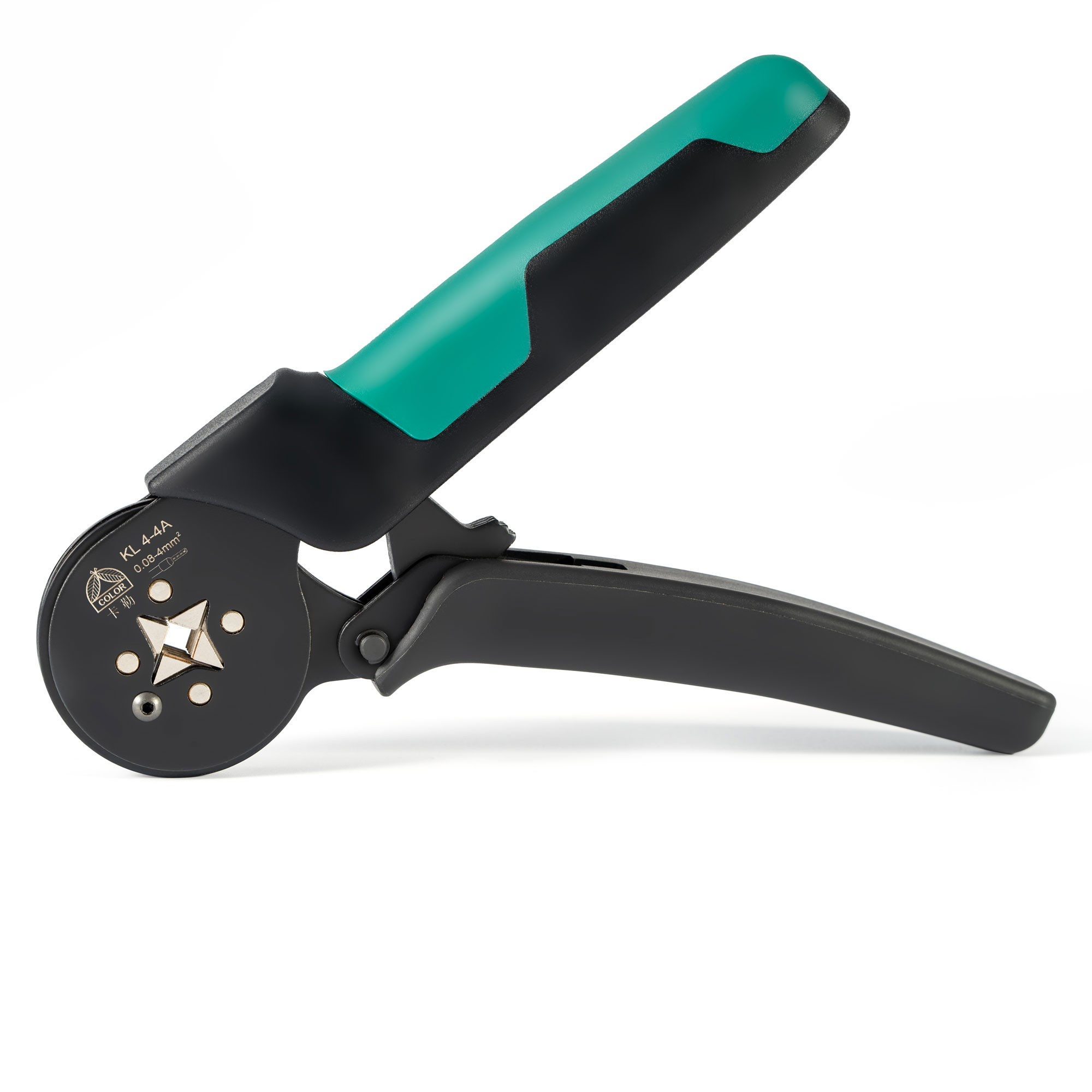
Evaluating your next end sleeve crimper requires careful attention to daily operational needs. Not all adaptive tools deliver the same performance. Selecting the right specifications guarantees long-term success.
Assess your required capacity before making a selection. A standard AWG 24-10 crimper covers the vast majority of standard control wire applications. These sizes represent the bulk of sensor wiring and relay connections. Alternatively, heavy-duty industrial variants handle much thicker power feeds, scaling up to 4 AWG. Buying a tool covering your exact daily spread prevents unnecessary bulk.
The physical shape of the crushed ferrule must match your specific terminal block design. Manufacturers offer two dominant profiles:
Square (Quadrangular): Best suited for modern spring-clamp and push-in terminal blocks. A square profile maximizes flat contact surface area, preventing wire rotation.
Hexagonal: Ideal for confined round spaces and traditional screw terminals. The hexagonal shape distributes pressure evenly, creating a near-perfect circular connection.
Durability dictates the lifespan of your investment. High-end models feature factory-calibrated precision and hardened steel construction. They endure harsh industrial environments easily. Furthermore, professional tools allow for minor tension adjustments. A small pre-tension wheel lets operators compensate for minor gear wear over the tool's lifespan. This calibration capability ensures the tool continues applying standard-compliant pressure years down the line.
Consider the physical impact on the operator. Look for multi-component grips combining hard plastics for stability and soft rubber for comfort. Handle span width matters significantly; excessively wide handles strain smaller hands. Overall weight also dictates long-term usability. A lightweight, well-balanced tool directly prevents wrist injury during marathon assembly sessions.
Possessing a premium self adjusting ferrule crimping pliers represents only half the equation. Operators must follow strict assembly realities to meet global safety standards continuously.
A proper connection must achieve a "gas-tight" state. This technical standard means the tool compresses the copper strands and the ferrule into a single, solid mass. The pressure eliminates all microscopic air gaps inside the sleeve. Preventing oxygen ingress stops oxidation and subsequent corrosion. Corroded wires generate high electrical resistance, which causes localized heating and eventual component failure. Achieving a true gas-tight joint fulfills rigorous safety frameworks like DIN 46228.
Never assume any ferrule works perfectly. A massive assumption risk exists in panel building. A flawlessly calibrated tool will still fail if paired with sub-standard materials. You must use DIN-compliant ferrules. Cheap, non-compliant end sleeves often feature inconsistent wall thickness or brittle metals. They crack under high-pressure crimps. Additionally, always verify you are using the correct sleeve length. Cutting corners on consumables defeats the purpose of adaptive technology entirely.
Industrial quality control requires vigilance. While we call these tools "self-adjusting," they still undergo mechanical wear. Industrial facilities must perform periodic pull-force testing. Technicians crimp a test wire, hang standard weights from it, and verify the ferrule holds tight. If the gear teeth wear down, the pressure drops. Regular verification guarantees your assembly line never ships a faulty panel due to a tired tool.
Selecting the appropriate quality tier requires analyzing your specific working environment. The right choice balances upfront investment against long-term reliability and labor savings.
Consider Tier-1 engineering for high-volume panel building, aerospace applications, or heavy industrial environments. In these high-stakes sectors, a single failed electrical connection costs exponentially more than the tool itself. Premium models deliver precise force distribution consistently. They boast exceptionally long lifespans, surviving hundreds of thousands of cycles without degrading.
Economy models serve distinct, lighter purposes effectively. Choose these for occasional hobbyist use, light prototyping, or low-stakes automotive wiring. If your project does not require strict DIN standard compliance, budget models perform adequately. They handle basic terminations well when thousands of daily cycles are not necessary.
Frame the higher upfront cost of premium models against tangible operational metrics. To assess the true value of your tool upgrade, measure the following factors:
Labor Minutes Saved: Track the time reduced per 100 terminations when switching from manual fixed-die tools to blind-insertion mechanisms.
Failure Reduction: Count the number of loose connections caught during quality control checks before and after implementing the new tool.
Rework Reduction: Calculate the hours saved by completely eliminating sizing-error rework from your assembly line.
Fatigue Mitigation: Assess the decrease in operator strain, which directly boosts late-shift productivity and focus.
Investing in a self-adjusting ferrule crimping plier ultimately guarantees termination consistency and rapid workflow speed. By removing manual sizing from the equation, you eliminate dangerous under-crimping errors. You also reduce hand fatigue significantly through advanced leverage mechanics.
Before finalizing your choice, evaluate your primary terminal block types. Decide whether a square or hexagonal profile best suits your main connection ports. Next, audit your standard wire gauge spread to ensure you buy a tool with the correct capacity. Implementing these specialized tools alongside high-quality, standard-compliant ferrules will elevate your wiring projects to professional, failure-free standards.
A: No. These tools apply specific multi-sided pressure intended only for thin-walled copper ferrules (end sleeves). Standard terminals require an indent or roll-style crimp.
A: The difference lies entirely in the capacity range. An AWG 24-10 handles standard control wiring tasks easily. Meanwhile, a wider range tool (28-6) utilizes a more complex internal linkage to accommodate both micro-wiring and thicker power feeds simultaneously.
A: If ferrules easily pull off the wire after a complete ratchet cycle, or if the tool frequently jams before releasing, action is needed. The internal pre-tension wheel may need adjustment, or the internal gears might require total replacement.
A: Yes. While both profiles create highly secure connections, a square crimp often aligns perfectly with the flat clamping surfaces of modern push-in and spring-cage terminal blocks. Conversely, hex profiles suit round connection ports better.


