
- All
- Product Name
- Product Keyword
- Product Model
- Product Summary
- Product Description
- Multi Field Search
Please Choose Your Language

Views: 0 Author: Site Editor Publish Time: 2026-05-27 Origin: Site


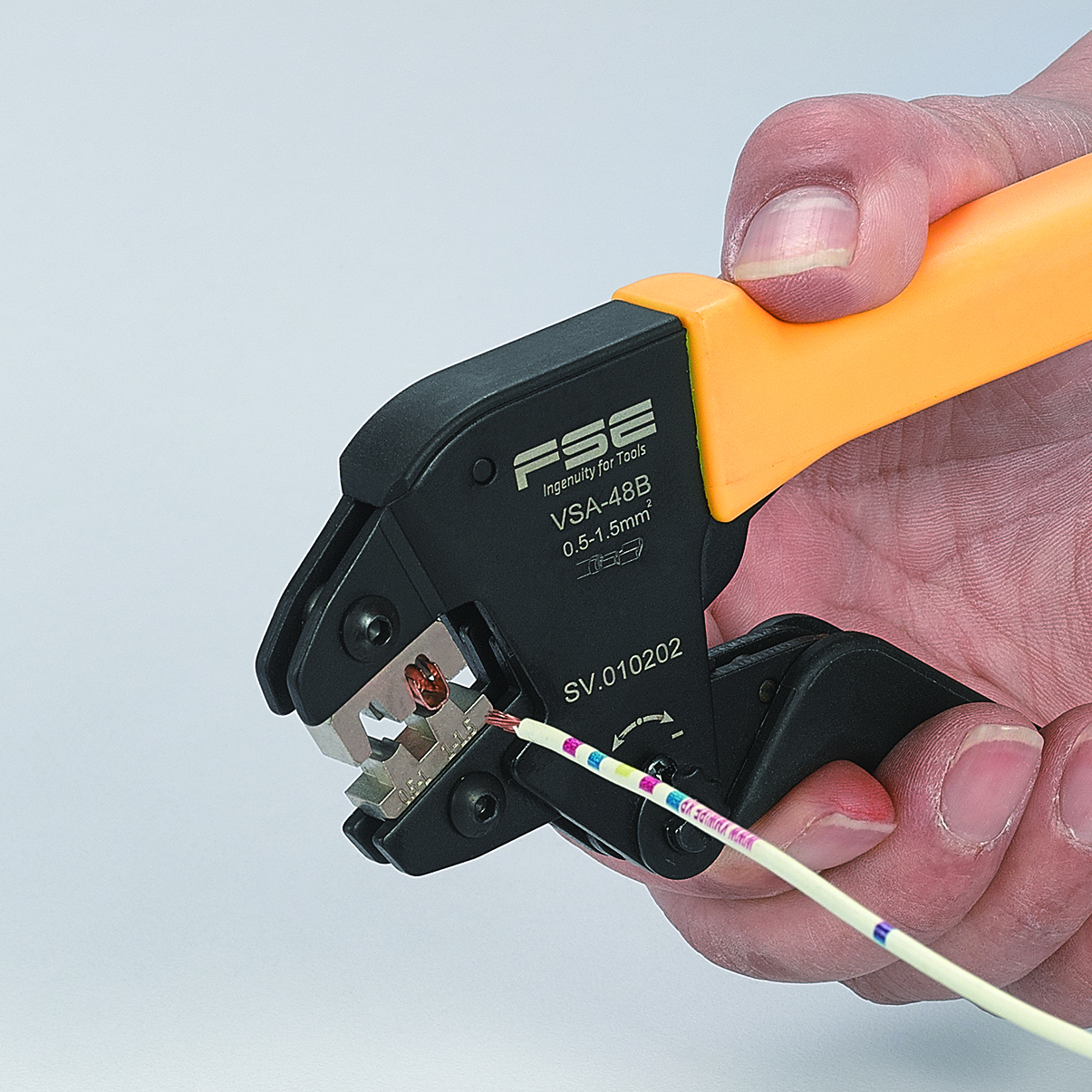
You want to know how to use a wire crimping tool? It’s easier than you might think, even if you’re a beginner. With a reliable tool like the FSE VSA 28B/48B, you can create strong connections quickly. Just follow the right steps and you’ll get great results every time.
Get your tools and materials ready before you start crimping. Here’s a simple checklist:
Stranded wire is best for crimp connectors.
Use wire connectors that fit your wire gauge.
A wire stripper helps you take off the insulation.
You need crimping pliers, like the FSE VSA 28B/48B wire crimping tool.
Wear safety glasses to keep your eyes safe.
Stranded wire works better than solid wire for this job. Pick good connectors that fit your wire size. A wire stripper keeps the wire strands safe. The right crimping pliers help you make a strong crimp.
There are many connector types for different jobs. This table can help you pick the right one:
Type of Connector | Description & Use |
|---|---|
Butt Connectors | Join two wires end-to-end, great for repairs |
Splice Connectors | Connect several wires, used in junction boxes |
Terminal Blocks | Organize multiple connections in one spot |
Twist-On Connectors | Twist wires together, common in homes |
Push-In Connectors | Quick installs, no twisting needed |
Lever Connectors | Easy to use, reusable, work with many wire types |
Crimp Connectors | Strong, permanent, good for places with vibration |
Specialty Connectors | For outdoor, grounding, or special needs |
Pick a connector that fits your wire gauge and project. Using the wrong connector can make a bad connection or even cause a fire.
Tip: Always be careful when using crimping tools!
Put on safety glasses to protect your eyes.
Look at your crimping pliers for damage before you use them.
Make sure your crimp tool fits your wire and connector size.
Keep your crimping pliers dry and close the handles when storing.
Try crimping on scrap wire to practice using your wire crimping tool.
If you follow these tips, you will get safe and strong results every time you use your crimping pliers.
Ready to make a strong electrical connection? You can do it with the right crimping pliers and a little patience. Let’s walk through step-by-step instructions so you can use your wire crimping tool like a pro.
Start by picking the best crimping tool for your project. The FSE VSA 28B/48B is a great choice because it has a ratchet system, ergonomic handles, and interchangeable die sets. These features help you get consistent results and make the job easier.
When you choose your connector, match it to your wire gauge. If you use the wrong size, your crimp might be loose or crushed. Always check the connector and the cavity on your crimping pliers. Here are some tips to help you avoid mistakes:
Never use a die set meant for a larger wire on a smaller wire. For example, don’t use a 6 AWG die on a 10 AWG wire.
Make sure the connector fits snugly on your wire.
Use the correct die set for your wire size. Proper die alignment gives you a uniform crimp and reliable connection.
If you want your crimp to last, always use the right tool and connector for the job.
Before you start crimping, you need to prepare your wire. Follow these step-by-step instructions:
Cut the wire to the length you need using cable cutters.
Strip off about 1/4 inch to 1/3 inch of insulation from the end with a wire stripper. Don’t nick the strands.
If you have stranded wire, twist the strands gently to make a tight bundle.
Make sure the bare copper reaches the end of the connector barrel but doesn’t stick out.
You want a clean cut and a tight bundle. Insert the wire fully into the connector barrel. The insulation should butt up against the connector’s insulation. This helps prevent corrosion and shorts.
Now you’re ready for attaching the connector and making the crimp. Here’s how you do it:
Pre-load the connector in your crimping pliers. Place the terminal into the correct die slot and squeeze the handles just enough to grip the connector lightly.
Use your free hand to insert the stripped wire into the connector. Make sure it’s straight and fully seated.
Squeeze the crimping pliers handles all the way. The ratchet system on the FSE VSA 28B/48B ensures you apply the right force and don’t release halfway.
Wait for the ratchet cycle to finish. This guarantees a complete crimp every time.
Proper force during crimping creates a strong mechanical bond. Your crimp will stand up to vibration and movement. If you use crimping tools with a ratchet, you get consistent pressure and reliable results.
Here’s a quick table of common mistakes and how to avoid them:
Mistake | Description | How to Avoid |
|---|---|---|
Using the Wrong Cavity or Connector Size | Loose or crushed connections | Match connector to wire gauge and use the proper notch on your crimping tool |
Incorrect Strip Length & Not Inserting the Wire Fully | Weak electrical contact | Measure strip length and insert wire fully |
Releasing Halfway (Incomplete Crimp) | Loose connection | Use a ratcheting crimping tool for complete compression |
Soldering Wires Before Crimping | Loose connections over time | Crimp directly onto stripped stranded wire |
No Sealing or Strain Relief | Premature failure | Use connectors with sealing and strain relief |
Don’t rush when attaching the connector. Take your time and check your alignment before you crimp.
After you finish crimping, you need to check your work. Inspection is important for safety and reliability. Here’s what to look for:
Even deformation across the barrel. This means you applied uniform force.
Symmetrical compression. The crimping die should line up perfectly.
A slight “bell mouth” at the wire entry point. This shows you didn’t shear the wire strands.
No wire strands sticking out of the crimp zone.
Wire insulation should not be pinched inside the crimp area.
You can use a pull test to check mechanical strength. Grab the wire and give it a firm tug. If the wire stays in place, your crimp is solid. For extra assurance, you can use standardized pull testing methods like IPC/WHMA-A-620 or UL 486.
Here’s a table of visual and mechanical indicators for a successful crimp:
Indicator Type | Description |
|---|---|
Visual Indicator | Even deformation across the barrel, indicating uniform force application for a gas-tight connection. |
Visual Indicator | Symmetrical compression showing proper alignment of the crimping die. |
Visual Indicator | Slight 'bell mouth' at the wire entry point, indicating no shearing of wire strands. |
Visual Indicator | No protruding wire strands outside the crimp zone, ensuring circuit integrity. |
Visual Indicator | Wire insulation not pinched within the crimp area, allowing for necessary metal-to-metal contact. |
Mechanical Indicator | Pull test to validate tensile strength and cold-weld bond integrity. |
Mechanical Indicator | Standardized pull testing using calibrated equipment to ensure connections meet industry standards. |
If your crimp passes these checks, you’ve made a safe and reliable connection.
You can also do resistance testing or cross-section analysis if you want to be extra sure. Most beginners stick to visual inspection and a simple pull test.
With these step-by-step instructions, you can use your wire crimping tool to make strong, secure connections. Practice makes perfect, so try crimping on scrap wire before you work on your main project. Good crimping pliers and careful technique will help you get great results every time.
You can learn wire crimping if you follow easy steps. Keep these tips in mind for good results:
Take off just enough insulation from the wire.
Make sure your wire and connector fit your tool.
Try crimping on extra wire first to get better and avoid errors.
Pick good tools so your connections are safe and work well every time.
Give the wire a firm tug. If it stays in place and does not slip out, you made a good crimp.
No, you should not reuse crimped connectors. Always use a new connector for each wire to keep your connection safe.
You can use wires from 23-17 AWG with the 28B and 22-16 AWG with the 48B. Check your wire size before crimping.


