
- All
- Product Name
- Product Keyword
- Product Model
- Product Summary
- Product Description
- Multi Field Search
Please Choose Your Language

Views: 0 Author: Site Editor Publish Time: 2026-08-21 Origin: Site


Selecting the wrong wire terminal does not just cause minor installation delays. It leads to critically loose connections, sudden voltage drops, and potential arcing under severe vibration. You might assume a connector is merely a generic component. However, precision matters immensely in electrical engineering. Many technicians and suppliers incorrectly use the terms "spade" and "blade" interchangeably. This widespread industry confusion creates frustrating procurement errors and halts entire assembly lines. We must establish a clear, technical distinction between the two components. Understanding these fundamental differences helps engineers, procurement teams, and technicians specify the exact connector required for their mechanical and electrical constraints. You will learn the specific shapes, primary applications, and vibration tolerances of each type. We will explore how insulation materials and barrel designs dictate long-term durability. By following this guide, you can confidently eliminate connection failures and ensure robust wiring harnesses for any project.
Shape & Function: A spade terminal features a forked shape designed to slide under a screw or stud, while a blade terminal features a flat, rectangular pin designed to plug into a female receptacle.
Primary Applications: Spades are ideal for terminal blocks and control panels where screws are present; blades are standard for quick-disconnect applications like automotive relays and audio systems.
Vibration Tolerance: Neither terminal offers the high vibration resistance of a ring terminal, but their performance depends heavily on mating force and screw torque.
Specification Variables: Insulation material (e.g., PVC vs. Nylon) and barrel design dictate installation speed and durability.
Industry veterans understand the historical roots of this confusion. Engineering forums frequently debate these terms. You will see technicians arguing over proper naming conventions almost daily. Push-on quick disconnects are routinely and mistakenly labeled as "spades." We call this persistent issue the "Spade Debate." It frustrates everyone involved in electrical wiring projects. Early wiring schematics often used generic symbols for any disconnectable joint. Over decades, field jargon blurred the lines between completely different connector shapes. You will often hear mechanics ask for a "spade" when pointing directly at a relay plug. This linguistic habit carries over into modern inventory systems.
We must define the baseline clearly to break this cycle of misinformation. A true spade acts as a U-shaped or fork-like connector. It physically wraps around a threaded post or screw. Conversely, a true blade acts as a flat, knife-like plug. It slides straight into a friction-fit female receptacle. Precision in this language matters greatly. Highlighting incorrect terminology during procurement reveals massive hidden project delays. You deal with incompatible wire harness assemblies when parts arrive. You end up with mismatched male and female ends. Engineers must halt testing while you wait for replacement parts. Proper naming conventions prevent these logistical disasters. Specifying a spade terminal and blade terminal accurately keeps your production schedule strictly on track.
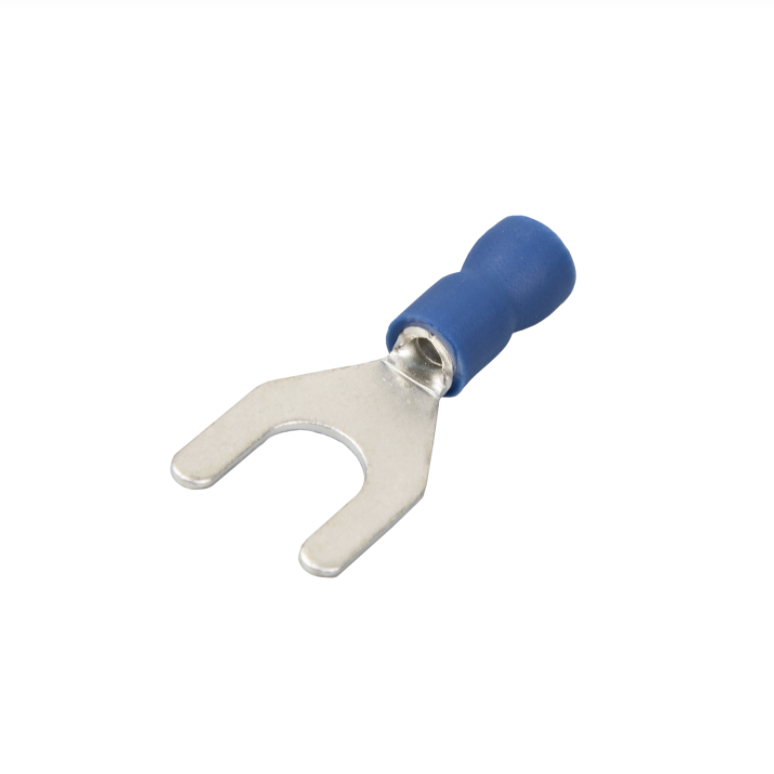
Let us thoroughly evaluate the mechanical design of the forked connection. It utilizes a highly specific forked opening. This opening allows you to insert the connector without completely removing the fastening nut or screw. You simply back the screw out a few turns. You slide the metal fork underneath the screw head. Finally, you torque the fastener back down to the required spec. This simple sequence creates profound operational advantages for field workers. You will achieve significantly faster maintenance times. Swapping out aging components on dense terminal blocks becomes remarkably efficient. Compare this workflow directly to using ring connectors. Ring connectors force technicians to remove the entire screw from the block. If you drop a tiny screw inside a cramped, dimly lit control panel, you lose precious time retrieving it.
When specifying your bill of materials, you must pinpoint key variations. An easy entry spade terminal features an integrated, funneled barrel design. This internal funnel actively prevents wire strand fold-back during insertion. It increases installation speed on the assembly line and drastically reduces frustrating crimp failures. You should also evaluate locking or flanged variants. Manufacturers design these with specially modified, hooked tips. They snap tightly around a threaded stud. This mechanical snap adds an invaluable layer of security against gradual loosening.
We must also discuss the practical insulation realities you face. The standard PVC insulated terminal remains a dominant choice globally. It provides highly visible, intuitive color-coding for different wire gauges. It performs exceptionally well in standard, climate-controlled environments. However, industrial applications often generate extreme heat. You should select bare metal or tough nylon options for higher heat environments. PVC material can deform or melt if ambient temperatures exceed its designated thermal rating.
Now we shift focus to the flat plug variant. The mechanical design revolves entirely around a solid, flat rectangular pin. It relies exclusively on friction-fit mating dynamics. You push it directly into a corresponding female receptacle. You will also see them utilized heavily in specific spring-clamp terminal blocks.
The operational advantages focus on raw speed and simplicity. This streamlined design enables rapid push-on and pull-off connections. You require absolutely zero tools for mating or disconnecting once you finish the initial crimp. Assembly line workers can snap together complex wiring harnesses in mere seconds. Field repair technicians can replace faulty relays using only bare hands. This tool-less interaction speeds up maintenance cycles immensely.
You must carefully specify the correct physical variation for your environment. Standard flat blades handle routine, stationary connections flawlessly. However, high-vibration environments demand better physical retention. A lipped blade terminal features a distinct raised lip or metal bump on its surface. This physical bump locks aggressively into specialized female receptacles. It actively prevents accidental pull-out under sudden mechanical tension.
Common applications for these parts span across massive global markets. You will find them buried deep within high-density wire harnesses. They serve as the standard interface for automotive fuse blocks throughout the automotive industry. Home audio systems, heavy machinery, and modular component swapping stations rely heavily on them. They excel anywhere you need modularity without reaching for a screwdriver.
Choosing correctly requires a rigid decision framework. We base this framework on four primary factors. First, analyze your exact connection interface. Do your electrical components use threaded posts or terminal screws? You must choose the spade. Do your components feature female friction-slots or relay sockets? You must choose the blade.
Vibration and retention pose the second major consideration. Blades maintain their electrical connection via active spring tension inside the receptacle. The female housing physically pinches the flat pin. Spades rely entirely on the downward mechanical torque of the clamping screw. They remain highly vulnerable if the screw backs out due to heavy machine vibration.
Mating frequency determines your long-term success. Blades are vastly superior for high-frequency connection and disconnection cycles. You can plug and unplug them safely hundreds of times. They glide smoothly without stripping metal. Spades will quickly wear out screw threads over time if technicians over-torque them repeatedly.
Finally, evaluate your physical space constraints. Modern electronics pack more features into smaller housings. Blades typically allow for tighter, side-by-side clustering. You can stack them remarkably close together in multi-pin connector housings.
Application Factor | Spade Connectors | Blade Connectors |
|---|---|---|
Primary Interface | Screws and Studs | Female Friction Receptacles |
Vibration Resistance | Low (Unless screw is locked) | Medium (Spring tension dependent) |
Mating Frequency | Low (Permanent installs) | High (Frequent swapping) |
Space Efficiency | Requires wide spacing | Allows dense clustering |
Even the best components fail if you ignore implementation risks. Crimping failures rank as the leading cause of electrical fires. Technicians frequently over-crimp a plastic sleeve out of habit. This excessive physical pressure causes invisible micro-tears in the insulation. These tiny rips expose the bare copper wire to ambient moisture and harsh chemicals. Oxidation begins immediately. You must calibrate your crimping tools regularly to prevent this hidden damage.
Material selection represents another major quality consideration. Procurement teams should always verify the internal core material of the connector. Electrolytic copper offers significantly superior electrical conductivity compared to cheaper brass alloys. Brass heats up much faster under high electrical loads. You should also demand high-quality tin-plating on the exterior. Tin-plating ensures robust corrosion resistance in humid, salty, or industrial environments.
Strict AWG matching prevents catastrophic joint failures. You face a strict necessity of matching wire gauge to standard terminal color codes. Red components fit 22-18 AWG wiring perfectly. Blue components grip 16-14 AWG wiring safely. Yellow components secure 12-10 AWG wiring tightly. You must respect these limits. This strict adherence guarantees a true gas-tight crimp. A proper gas-tight crimp blocks oxygen completely, preventing internal corrosion for decades.
Always strip the wire to the exact length specified by the manufacturer.
Perform a manual pull test immediately after completing the crimp.
Use a ratcheting crimp tool to guarantee full compression every single time.
Inspect the barrel visually to ensure no stray wire strands protrude outside the insulation.
Choosing the right connection point prevents catastrophic system failures. You must logically separate these two components in your inventory and design schematics. Choose a spade variant specifically for screw-driven terminal blocks. Select a blade variant for quick-disconnect mating scenarios where speed is essential. Using precise terminology ensures you procure the exact components your project requires.
Take the following actionable next steps to improve your wiring processes:
Audit your physical connection points across your current wiring schematics.
Verify your exact wire gauge requirements against standard industry color codes.
Request specification sheets and physical samples before placing bulk orders.
Test crimp tool compatibility with your chosen insulation types to ensure gas-tight seals.
A: Yes, for convenience, but not in high-vibration environments where a loosened screw could allow a spade to slip out. Ring terminals offer fail-safe retention.
A: "Quick-disconnect" usually refers to the female receptacle, while the blade is the male counterpart. Together, they form a quick-disconnect system.
A: The inner funnel guides frayed wire strands smoothly into the barrel, reducing installation time and preventing "bird-caging" of the wire before crimping.


