
- All
- Product Name
- Product Keyword
- Product Model
- Product Summary
- Product Description
- Multi Field Search
Please Choose Your Language

Views: 0 Author: Site Editor Publish Time: 2026-08-02 Origin: Site


Cutting 500mm² (approximately 1000 MCM) industrial cable remains a high-stakes mechanical task for electrical contractors and utility workers. Relying on undersized tools consistently leads to severe cable deformation, poor terminal connections, and dangerous operator fatigue over a long shift. A dedicated cable cutter 500mm² is engineered specifically for heavy commercial, industrial, and utility grid applications where precision and mechanical advantage are strictly non-negotiable.
For procurement teams, project managers, and master electricians, selecting the right cutter requires evaluating mechanical force limits, material compatibilities, and strict safety compliance. Choosing incorrectly often results in catastrophic tool failure or workplace injuries. This guide breaks down exact field use cases, internal mechanism differences, and comprehensive procurement evaluation criteria. You will learn how tool geometry impacts daily field operations. We will explore material restrictions that prevent brittle blade snapping. Finally, you will discover field-tested criteria to standardise tool selection across your entire field crew.
Primary Application: Built for terminating large-gauge industrial power distribution lines, specifically stranded copper and aluminum.
Mechanism Dependency: At 500mm², ratcheting or hydraulic mechanisms are practically mandatory; standard high-leverage tools max out at lower gauges.
Material Limitations: Most 500mm² cutters will suffer catastrophic blade failure if used on steel-reinforced cables (ACSR) unless explicitly rated for it.
Safety Imperative: Working in high-voltage commercial environments requires verifying true VDE-certified insulation ratings.
Standard cutting tools fail dramatically when facing massive conductors. They crush large-gauge cables during the initial bite phase instead of slicing through them. This crushing action flattens the conductor profile, pushing the outer strands out of alignment. Consequently, operators face frayed, uneven ends that complicate lug insertion. Frayed ends frequently fail micro-ohm resistance testing during the final termination phase. Poor terminations generate excess heat, creating significant fire risks inside electrical panels. A dedicated tool ensures a shear, factory-clean cut. You need this precision to maintain the structural integrity of the individual copper or aluminum strands.
Utility and grid infrastructure teams rely heavily on these specialized tools daily. Field crews slice through thick underground mains during neighborhood grid expansions. They handle massive overhead distribution lines under harsh environmental conditions. The correct cutter slices through these thick profiles smoothly without distorting the round conductor shape. You achieve a perfectly clean surface ready for complex splicing operations.
Commercial power distribution presents similarly demanding challenges. Electricians terminate extremely thick lines in main breaker panels to feed massive facilities. They work inside large transformers and complex industrial switchgears. Space is often tight, requiring clean tool operation. A precise cut prevents stray strands from escaping the terminal block, which eliminates potential arc flash hazards.
Functioning primarily as a highly reliable copper cable cutter, this equipment handles varying internal wire structures effortlessly. It easily accommodates Class 2 rigid stranded wire and Class 5 flexible conductors. You can also deploy it effectively for large-diameter aluminum power feeds. Matching the curved jaw opening precisely to the cable's outer diameter prevents the metal from binding during the cut.
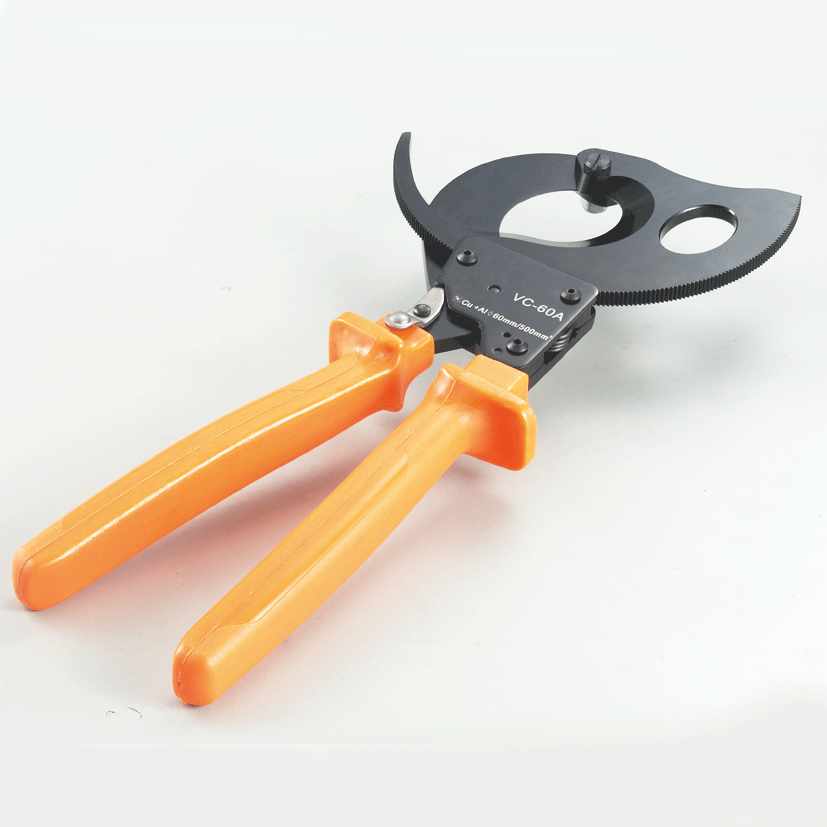
Choosing the correct mechanical advantage dictates both operator safety and job execution speed. We categorize heavy-duty wire tools by how effectively they multiply manual human force into raw cutting power.
Standard high-leverage tools perform exceptionally well on smaller gauges. They are practically ideal when you need a reliable 240mm² cable cutter for standard panel work. However, attempting to apply direct manual high-leverage force to a massive 500mm² cable requires dangerous levels of physical exertion. Operators face severe ergonomic injuries over a long operational shift. Musculoskeletal strain and carpal tunnel flare-ups become major liabilities for the crew.
Ratcheting mechanisms represent the absolute industry standard for 500mm² capacities. They allow for controlled, step-by-step cutting. The internal steel gear holds the blade firmly in place after every squeeze of the handle. This progressive action reduces required hand force significantly. Furthermore, it enables single-handed operation in highly confined spaces. You will find this feature invaluable when working deep inside muddy trenches or contorted within tight electrical vaults where two-handed leverage is physically impossible.
Hydraulic and battery-powered units dominate ultra-high-volume manufacturing environments. They handle hundreds of repetitive cuts daily without stressing the user's joints. They demand a much higher upfront capital investment. However, they deliver the lowest operator fatigue possible for pre-fabrication shops.
Let us compare these three primary mechanism types side-by-side to guide your selection:
Mechanism Type | Optimal Capacity Limit | Operator Fatigue Level | Best Field Use Case |
|---|---|---|---|
Standard High-Leverage | Up to 240mm² | High (on large cables) | Quick cuts on smaller branch circuits. |
Mechanical Ratcheting | Up to 500mm² | Low to Medium | Tight spaces, trenches, panel terminations. |
Hydraulic / Battery | Exceeds 500mm² | Extremely Low | High-volume repetitive shop cutting. |
Understanding transparent assumptions about blade strength prevents ruined equipment and project delays. Implementation realities on the active job site often contradict manufacturer specifications if crews lack proper training.
The ACSR trap destroys more professional tools than any other misuse. Operators frequently attempt to cut Aluminum Conductor Steel Reinforced (ACSR) cable out in the field. They mistakenly use standard copper or aluminum blades for this rugged structural wire. They also attempt to shear Steel Wire Armor (SWA) jackets. The solid steel core hidden inside these cables shatters standard precision blades instantly.
Blade hardness versus brittleness explains this catastrophic failure perfectly. Manufacturers design blades to deliver incredibly clean copper shears. They harden the drop-forged steel to hold a razor-sharp edge. However, this specialized hardened steel remains far too brittle to compress structural iron or steel. It will chip, dent, or completely snap under the immense compressive load of an ACSR core. A heavy-duty aluminum cable cutter slices soft conductive metal effortlessly but fails instantly when it strikes iron.
Verification stands as your only reliable defense against equipment destruction. Always cross-reference the specific tool specification sheet. Check structural wire ratings against standard conductive wire ratings before deployment.
Common Mistakes to Avoid:
Attempting to cut structural guy wires or steel suspension ropes.
Twisting the handles laterally during the bite phase, which warps the pivot bolt.
Ignoring the maximum outer diameter (OD) capacity of the jaw.
Follow this simple verification checklist on site:
Read the printed cable jacket for exact material composition data.
Inspect the cutter blade for stamped ACSR or steel-rated identifiers.
Perform a gentle test bite on a scrap section if the wire composition remains unknown.
Stop squeezing immediately if the ratcheting gear binds excessively or feels abnormally rigid.
Working near energized zones demands strict compliance-aware thinking from every team member. Demonstrating authoritativeness in electrical safety practices saves lives and prevents catastrophic facility damage.
Dielectric testing forms the critical foundation of live-panel work safety. When working near potentially energized panels, standard rubber grips fail to protect you from voltage jumps. Using a certified insulated cable cutter acts as a strict OSHA and VDE requirement in these scenarios. Regulatory bodies do not compromise on this fundamental safety rule.
The 1000V standard clearly separates professional protective gear from cheap consumer tools. You must actively differentiate between standard "comfort grip" handles and true dielectric insulation. Comfort grips offer strictly zero electrical protection. They exist merely to reduce hand blisters and improve grip friction. True dual-layer, factory-tested 1000V VDE-rated insulation actually blocks lethal currents. This dual-layer system often utilizes contrasting safety colors. If the outer layer wears down from rough handling, the bright inner color reveals itself. This visual indicator warns you to replace the tool immediately before your next shift.
Routine maintenance directly impacts field safety. Inspecting ratcheting gears for trench debris is mandatory. Dirt stuck deep inside the gear teeth prevents the pawl from locking, causing unexpected handle slipping. Test your blade alignment regularly. Misaligned blades can suddenly slip sideways under maximum torque. A sudden physical slip near a live busbar frequently causes a worker to breach the approach boundary, resulting in lethal arc flashes.
Best Practices for Tool Safety:
Clean the exposed gear track meticulously after every muddy trench operation.
Apply a dry PTFE lubricant to the pivot points to prevent debris accumulation.
Store the tool in a rigid case to prevent microscopic blade fractures during transit.
Selecting the right model requires carefully matching technical features to your daily outcomes. Shortlisting logic must prioritize field durability and ergonomic safety over superficial design elements.
Look carefully for models offering replaceable cutting blades. High-capacity tools endure severe punishment. A chipped blade should not require replacing the entire tool assembly. Swappable drop-forged blades extend the operational lifespan of your equipment significantly. This modularity ensures uninterrupted workflows on remote sites where supply runs are impossible.
Evaluate the weight-to-capacity ratio with extreme care. Heavy tools cause dangerous drop hazards when electricians work on elevated ladders or boom lifts. Compare the total weight of heavy-duty ratcheting models against the daily physical demands placed on the user. Lighter tools cast from high-grade aircraft aluminum reduce tool belt fatigue while maintaining rigid structural integrity.
Jaw geometry dictates the ultimate quality of the cut. Prioritize tools featuring a specialized "shear-cut" or tightly curved jaw design. This crescent geometry captures the massive 500mm² cable securely and pulls it inward toward the pivot point as you squeeze. Conversely, flat anvil-style jaws tend to push the thick cable out of the bite. This pushing action causes jagged edges and requires you to constantly reposition the tool.
Next-step actions for site managers:
Audit your active site's most common cable types and outer diameters.
Document the exact copper-to-aluminum ratio your crew processes weekly.
Match the mechanical style (ratchet vs leverage) to your specific spatial constraints.
Standardize one specific brand across the entire crew to simplify spare blade inventory.
Evaluation Criterion | What to Inspect | Direct Field Benefit |
|---|---|---|
Blade Replaceability | Removable hex bolts on the jaw assembly. | Eliminates full tool replacement after accidental steel cuts. |
Jaw Curvature | Deep crescent shape enclosing the cable. | Prevents cable slipping; ensures perfectly round terminal ends. |
Insulation Rating | Visible VDE / 1000V stamped into the grip. | Guarantees compliance and protects against accidental voltage. |
Release Mechanism | Thumb-actuated reverse lever. | Allows operators to back out of a jammed cut safely. |
A 500mm² cable cutter stands as a vital precision-engineered investment for serious electrical operations. It actively protects operator joints from severe repetitive strain injuries while speeding up trench work. More importantly, it guarantees the structural integrity of high-amperage electrical terminations. Flawed, crushed cuts inevitably lead to overheating panels, whereas precise shears ensure optimal surface contact inside the mechanical lug.
Do not compromise on the internal cutting mechanism. Prioritize heavy-duty ratcheting or hydraulic models for anything over 240mm² to protect your crew's health. Enforce strict material limitations aggressively on the job site. Keep structural steel and ACSR away from standard precision blades to maximize tool lifespan. Taking these calculated steps guarantees reliable performance across your most demanding utility and commercial projects.
A: 500mm² roughly translates to 1000 MCM (kcmil). Ensure your tool is explicitly rated for this specific metric or imperial maximum capacity before attempting a cut.
A: No. Unless explicitly labeled for steel or ACSR applications, the hardened precision blades will suffer immediate, irreversible damage such as severe chipping or snapping.
A: For heavy commercial field use, inspect and clear debris weekly. Apply dry lubricant monthly to prevent dirt buildup in the internal gear teeth and pawl.
A: While technically not required for proven de-energized lines, safety compliance best practices dictate using 1000V rated tools as a necessary failsafe against accidental re-energization.


