

Views: 0 Author: Site Editor Publish Time: 2026-08-19 Origin: Site


Electrical failures frequently trace back to compromised wire terminations. Connector selection is a critical reliability factor across various industries. Automotive, marine, and manufacturing applications demand highly secure electrical joints. We often see entire systems fail because one crimp lacked adequate mechanical strength.
A butt splice connector provides a permanent, end-to-end crimped joint. It joins two stranded or solid wires reliably. When moisture, heat, or vibration attacks the joint, a subpar connection degrades quickly. Choosing the wrong terminal can lead to severe safety risks.
Moving beyond basic wire joining requires precise material knowledge. We will explore how different insulation specifications determine mechanical durability. You will learn how barrel construction impacts moisture resistance. Finally, we cover the strict compliance standards necessary for building a safe, reliable connection.
Purpose: Butt splices join wires end-to-end in tight spaces, offering superior vibration resistance compared to a standard screw on wire connector.
Material Selection: Choices range from bare seamless barrels for custom heat shrink applications to integrated nylon or adhesive-lined heat shrink for harsh environments.
Risk Mitigation: Proper installation requires matching the wire gauge (AWG) to the terminal color code and utilizing a ratcheting crimper to ensure a gas-tight seal without piercing the insulation.
Evaluation: Purchasing decisions should index on environmental exposure (moisture/heat), mechanical stress (pull force), and necessary certifications (UL/RoHS).
An inline cylindrical electrical wire terminal forms the core of many reliable circuits. Manufacturers design them to house two stripped wire ends. These bare conductors meet squarely in the middle. You secure them by mechanically crimping the metal barrel.
We look at the structural profile to understand terminal effectiveness. High-quality designs include an internal wire stop. Technicians often call this a dimple. This small indentation prevents over-insertion of the wire. It ensures you apply equal crimping force across both sides. Equal distribution guarantees optimal electrical conductivity.
Parallel connectors offer a completely different wiring approach. They mate wires side-by-side rather than end-to-end. We use parallel joints when vertical space allows stacking. However, butt splices excel in tight spatial constraints. They provide a low-profile inline joint. You need this slim profile for pulling wires through narrow conduits.
Contrasting these options against a standard screw on wire connector highlights important operational differences. A wire nut works well for static indoor enclosures. They are temporary and easily removable. Conversely, a butt splice creates a permanent bond. They sit flush against the cable bundle. They strongly resist mechanical vibration. Standard operating procedures (SOPs) mandate them for automotive repairs.
Connector Type |
Mating Style |
Vibration Resistance |
Primary Application |
|---|---|---|---|
Butt Splice |
End-to-end |
Very High |
Automotive, Marine, Industrial |
Parallel Splice |
Side-by-side |
Moderate |
Control panels, static machinery |
Screw-On (Wire Nut) |
Twisted grouping |
Low |
Indoor residential wiring |
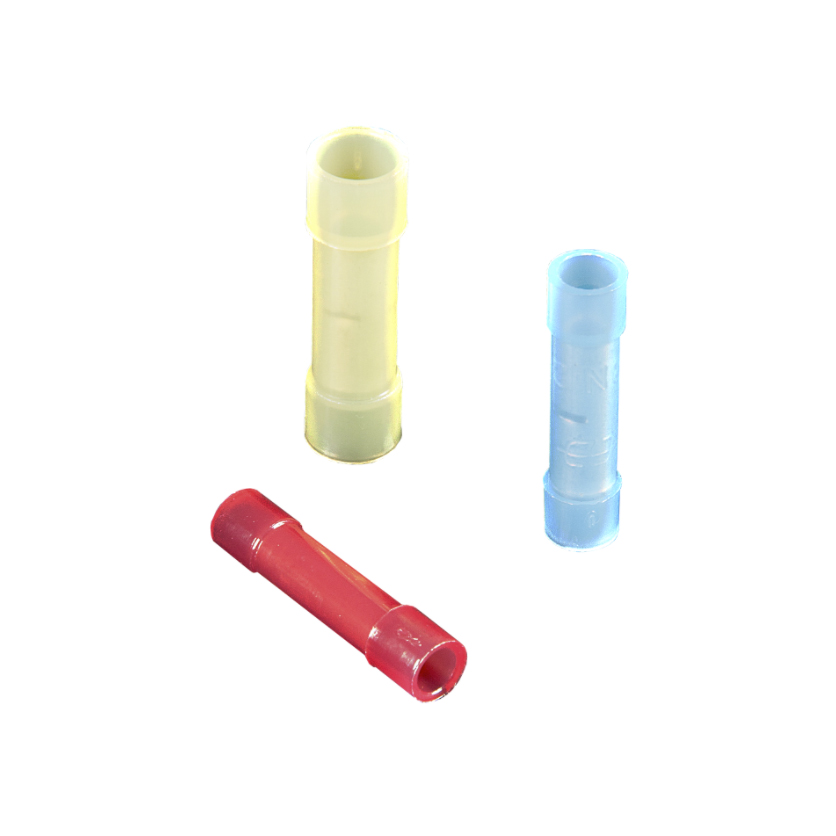
Selecting proper insulation guarantees environmental protection. We categorize these terminals by their outer jackets and internal barrel structures. Each material serves a highly specific environmental demand.
Non-insulated terminals utilize bare metal construction. They often feature a seamless butt splice design. You use them in extreme high-temperature applications. Standard plastics melt under severe heat. Technicians also choose them for custom applications. You can apply dual-wall heat shrink manually post-crimp.
Vinyl insulated terminals represent the entry-level commercial option. They feature a basic PVC plastic barrel. They are cost-effective but carry distinct operational risks. The rigid plastic remains prone to cracking. Extreme cold temperatures degrade the vinyl. High-stress crimping easily fractures the protective shell.
A nylon insulated connector provides a significant durability upgrade. Nylon delivers superior chemical resistance. It handles ambient heat better than vinyl. The material is partially translucent. This clarity allows for rapid visual inspection. You can confirm the wire seat before crimping. Nylon flexibly resists cracking during the harsh compression process.
Adhesive-lined heat shrink terminals represent the ultimate industry standard. We rely on them for marine environments. They protect exterior automotive wiring effectively. Applying targeted heat shrinks the jacket tightly around the wire. An internal adhesive layer melts simultaneously. It flows into the gaps. This forms a weatherproof, strain-relieving environmental seal.
Avoid vinyl in sub-zero environments to prevent jacket shattering.
Select translucent nylon when training new assembly technicians.
Demand adhesive-lined shrink tubing for any saltwater exposure.
Use bare seamless barrels inside high-heat engine bays.
Properly sizing your terminal prevents catastrophic electrical failures. We rely on standardized American Wire Gauge (AWG) measurements. The industry uses a universal color-coding system. This system eliminates guesswork during rapid assembly.
Color Code |
Wire Gauge (AWG) |
Typical Use Case |
|---|---|---|
Red |
22-18 AWG |
Sensors, LED lighting, data relays |
Blue |
16-14 AWG |
Switches, primary automotive circuits |
Yellow |
12-10 AWG |
Heavy motors, battery connections |
Mismatched sizes create massive safety risks. Down-sizing causes immediate physical pull-out. The barrel cannot grip enough copper strands. Up-sizing leaves excessive dead space inside the cylinder. This creates a loose connection. Loose connections generate voltage drops across the circuit.
Amperage and voltage ratings require strict verification. You must check maximum electrical load tolerances. These capacities depend directly on specific barrel thicknesses. Material conductivity plays a huge role here. Tinned copper provides excellent current flow. The tinning process naturally prevents surface oxidation.
Commercial builds require strict regulatory compliance. You should always check manufacturer spec sheets. Look for the UL Listed mark. Verify official CSA certification. Ensure strict RoHS compliance. These markers prove the terminal meets rigorous global safety standards.
Execution matters just as much as material selection. A gas-tight crimp remains the ultimate engineering goal. This specific seal prevents oxygen ingress. It blocks moisture from entering the micro-gaps. Stopping oxygen effectively stops internal corrosion.
Tooling choices dictate your overall success rate. Standard pliers crush the barrel unevenly. A calibrated ratcheting crimping tool is absolutely non-negotiable. Enterprise and OEM applications demand precise force. Ratcheting tools release only upon reaching the correct pressure threshold.
Strip wires precisely to the manufacturer-specified length. Avoid nicking any copper strands during stripping.
Seat the bare wire fully against the internal dimple. Ensure no stray strands remain outside the barrel.
Position the crimp jaw squarely over the metal barrel. Never compress the flared insulation directly.
Execute the crimp completely. Always perform a mandatory mechanical pull-test afterward.
Heat shrink activation requires highly careful handling. Environmental seals require a dedicated industrial heat gun. Attach a deflector nozzle to achieve uniform shrinkage. The deflector wraps the heat around the entire cylinder. This melts the internal adhesive evenly. Keep the gun moving constantly. Do not scorch or blister the outer jacket.
Even experienced technicians encounter assembly failures. Understanding common pitfalls improves long-term system reliability. We categorize these failures into mechanical and sourcing errors.
Under-crimping acts as a dangerous hidden hazard. A loose barrel fails to compress the wire strands fully. This failure leads to increased electrical resistance. High resistance causes severe localized heating. Eventual terminal failure becomes highly probable. Localized heating often escalates into a major fire risk.
Over-crimping causes equally severe physical damage. Excessive force ruptures the nylon or vinyl jacket. This compromises the dielectric strength of the insulation. A pierced jacket exposes the internal connection directly to oxidation. It also creates a high risk of grounding out against nearby metal frames.
Sourcing risks threaten large-scale manufacturing projects constantly. We strongly warn against unbranded inventory. Avoid low-purity copper terminals. Cheap alloys suffer from galvanic corrosion over time. Emphasize long-term system reliability. Always source pure electro-tin plated copper. High-quality plating prevents galvanic corrosion completely. It ensures stable conductivity across decades of use.
Selecting the correct terminal dictates circuit longevity.
Align your insulation material directly against environmental demands.
Adhere strictly to professional installation mechanics.
Calibrated tooling ensures a permanent gas-tight seal.
Next steps for engineers involve immediate field audits. Audit your application environments for vibration, moisture, and temperature extremes. Review manufacturer spec sheets carefully. Verify the exact AWG and insulation ratings. Ensure every crimping tool is properly calibrated. Complete these steps before standardizing a specific terminal for your assembly lines.
A: Yes, but stranded wire provides a more reliable crimp. Solid wire resists compression. If using solid wire, specific crimping dies are required. Special techniques prevent the terminal from slipping off the smooth copper surface.
A: A seamless barrel is extruded from a single piece of tubular metal. It prevents the barrel from splitting open under heavy crimping pressure. Cheaper seamed connectors are stamped and rolled. They often split apart during installation.
A: Standard nylon or vinyl connectors are not waterproof. True waterproofing requires adhesive-lined heat shrink terminals. You must melt the internal glue completely. This process seals out moisture and creates a marine-grade connection.
A: Most standard low-voltage butt splices are rated for up to 600V for building wire. Some are rated for 1000V in signs and fixtures. Always verify the specific terminal's UL rating against your local electrical codes.


