
- All
- Product Name
- Product Keyword
- Product Model
- Product Summary
- Product Description
- Multi Field Search
Please Choose Your Language

Views: 0 Author: Site Editor Publish Time: 2026-08-04 Origin: Site


Transitioning from manual cutting tools to battery-powered hydraulics represents a significant equipment decision for electrical contractors and utility teams. Relying on outdated manual tools slows down critical infrastructure projects. It also exposes operators to unnecessary physical strain. You quickly realize the operational case relies heavily on reduced operator fatigue. You also gain exact cut precision and significantly faster cycle times on high-voltage or heavy-duty installations. Clean cuts ensure proper lug seating and prevent electrical hot spots later. This guide breaks down the internal mechanics of a battery hydraulic cable cutter. We outline specific operational risks associated with these powerful tools in harsh environments. Finally, we provide a robust framework for evaluating tool specifications directly against your project requirements. You will learn exactly how these systems function internally. You will also discover how to select the optimal model to keep your daily operations running safely and efficiently.
Mechanism: Battery hydraulic cutters convert electrical energy into high-pressure hydraulic force (often 6 to 13 tons), driving a hardened steel blade through dense copper, aluminum, or steel-reinforced cables.
Efficiency: They reduce cut times from minutes (manual) to seconds, drastically lowering the risk of repetitive strain injuries (RSI) for linesmen.
Application Limits: Tool selection must strictly align with maximum cable diameter and material composition—using standard blades on armored cable without verification risks catastrophic tool failure.
Maintenance Reality: Long-term ROI depends on strict adherence to hydraulic fluid replacement and blade sharpening schedules.
Modern cable cutting relies on sophisticated internal engineering to replace brute human force. A high-capacity lithium-ion battery acts as the foundational power source. This battery energizes an advanced internal DC or brushless motor. Brushless motors generate less internal heat and eliminate routine carbon brush replacement. Voltage plays a massive role in overall performance here. Tools operating at 18V or 24V ensure consistent torque output under extreme loads. You need sustained power to drive the internal mechanisms without stalling mid-cut. Stalling while shearing thick conductors damages the blade and frustrates operators.
The true heart of the system is the two-stage hydraulic pump. It draws specialized fluid from a small internal reservoir. It then forces this fluid through precision-machined internal valves. This specific two-stage operation maximizes battery life and accelerates cycle speed.
Stage 1: The low-pressure, high-volume phase. The pump rapidly advances the blade directly to the cable surface. Moving the blade quickly through empty air saves valuable seconds during every cycle.
Stage 2: The high-pressure, low-volume phase. Once the blade meets the mechanical resistance of the conductor, the system shifts gears automatically. The fluid drives the internal piston forward under immense pressure.
This escalating fluid pressure actuates the piston and ram assembly. The linear force generated transfers directly to the cutting head. Tool designers use either a scissor-style or guillotine-style head to deliver this crushing force. The hardened steel blades easily shear through dense, multi-core conductors.
Safety and efficiency hinge entirely on the auto-retraction mechanism. An internal relief valve constantly monitors system pressure. Once it reaches the maximum rated limit—often exceeding 13 tons—the valve trips automatically. The hydraulic fluid bypasses the piston. A heavy-duty return spring then snaps the blade back to its starting position. This prepares the tool instantly for the next operational cycle.
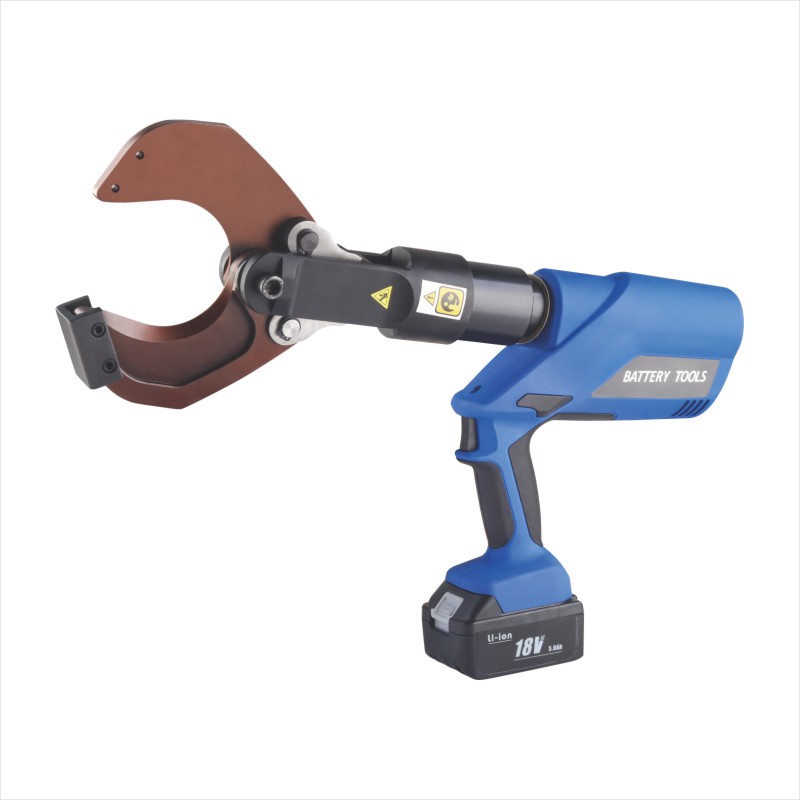
Operating a manual ratchet cable cutter on large-gauge wire takes a severe physical toll on utility crews. Workers must repeatedly squeeze wide, unwieldy handles against heavy resistance. This repetitive motion leads to rapid operator fatigue during long shifts. It also dramatically increases the risk of repetitive strain injuries (RSI) in the wrists and shoulders. Switching to a push-button hydraulic unit mitigates these physical risks instantly. It actively supports strict OSHA compliance by reducing physical exertion limits on demanding job sites. Operators can often manage the tool using just one hand.
Cycle speed differs drastically between the two methods. Ratcheting mechanisms require multiple manual pumps per cut. A standard cut on a thick conductor might take over a minute of strenuous, continuous effort. Conversely, battery hydraulics complete a full cutting cycle in just 3 to 10 seconds. This massive time savings multiplies rapidly across high-volume stringing projects or dense panel builds. Your teams accomplish more work before lunch than they previously managed in a full day.
Confined spaces amplify the challenges of utilizing manual tools. Working in deep utility trenches, underground vaults, or tight electrical panels restricts natural arm movement. A manual tool requires a wide handle-spread to function properly. Battery units eliminate this problem entirely. They frequently feature 360-degree rotating heads. Operators can easily angle the cutting jaws into narrow gaps. They keep the tool handle in a neutral, comfortable position throughout the entire process.
We must acknowledge the higher upfront acquisition cost of battery-powered units. However, we map this cost directly against raw labor hours saved. High-volume termination jobs finish days ahead of schedule when workers avoid manual fatigue. The ratio of investment to operational value favors hydraulic tools heavily when labor efficiency dictates project timelines. Faster operations mean fewer hours billed to specific tasks.
Understanding precise material limits prevents catastrophic equipment damage. Standard copper and aluminum (Cu/Al) cables present minimal mechanical resistance. Most standard hydraulic tools slice through these soft conductors cleanly and smoothly. Clean, undistorted cuts ensure proper termination seating. They prevent dangerous electrical hot spots during high-voltage transmission.
Heavy-duty applications introduce significant mechanical challenges. Linesmen frequently encounter ACSR (Aluminum Conductor Steel Reinforced) or steel wire armored (SWA) cables. These tough materials require specialized blade compositions. You need much higher tonnage to break through the rigid steel core without jamming. Procuring an armored cable cutter is non-negotiable in these scenarios. These specific models feature ultra-hardened blades engineered specifically to prevent edge chipping on steel strands. Standard blades will deform instantly upon striking steel.
Tool Category | Target Material Application | Maximum Outer Diameter | Typical Force Output |
|---|---|---|---|
Standard Cu/Al | Stranded Copper, Aluminum | Up to 50mm | 6 Tons |
High-Capacity Cu/Al | Thick Copper, Multi-core Power | Up to 85mm | 6 to 9 Tons |
Heavy-Duty / ACSR | ACSR, SWA, Guy Wire | Up to 40mm | 12 to 15 Tons |
Industry-standard sizing provides clear operational boundaries for procurement. Consider the widely referenced EC-85C cable cutter class. Models in this tier typically handle cables up to 85mm in diameter. Using this benchmark illustrates how supervisors align equipment capabilities directly with field realities. Purchasing a tool possessing insufficient capacity guarantees hardware failure on the first demanding job. Always verify the maximum outer diameter of the specific cables your team pulls regularly.
Even top-tier industrial equipment faces severe operational hazards. Hydraulic seal degradation ranks as a primary failure point over time. Micro-leaks develop slowly and silently inside the tool housing. Outdoor job sites expose tools to fine dirt, abrasive grit, and extreme temperature fluctuations. These elements degrade internal O-rings and polyurethane seals. Dirt entering the fluid acts like liquid sandpaper against precision valves. Compromised seals lead directly to internal pressure loss. This renders the tool completely ineffective when under load.
Blade misalignment and micro-chipping ruin tools instantly. This usually results from cutting materials outside the tool’s rated specification. Operators sometimes attempt to cut hardened steel guy wires using a standard Cu/Al blade. The steel instantly chips the brittle blade edge. It can also force the cutting jaws permanently out of alignment. A standard hydraulic cable cutter cannot survive improper material applications. You must train crews to identify cable types before pulling the trigger.
Environmental factors heavily impact mechanical performance. Freezing winter temperatures drastically affect lithium-ion battery discharge rates. Batteries drain much faster in the cold. They limit the total successful cuts per charge. Furthermore, sub-zero weather thickens the internal hydraulic fluid. Higher fluid viscosity temporarily reduces cutting efficiency. It significantly slows down the cycle speed until the internal components warm up through friction.
Maintaining strict service intervals mitigates most operational risks. Annual calibration and pressure testing remain absolute necessities. Professional servicing replaces worn internal seals. Technicians verify the relief valve trips at the exact correct tonnage. Adhering to these schedules maintains warranty validity and ensures maximum safety standards on the job site.
Selecting the perfect tool requires careful evaluation of technical specifications. First, you must calculate your exact tonnage requirements based on typical workloads. A 6-ton unit performs excellently for general electrical contracting and standard commercial wiring jobs. It remains lightweight and easy to maneuver overhead. However, heavy utility work, underground distribution, and transmission line construction demand a robust 12-ton or 15-ton tool. You must match the force output precisely to your toughest daily task.
Head design plays a crucial role in usability and durability in the field.
Open/Scissor Design: This style allows for faster, unrestricted cable positioning. Operators can slip the open jaws over a continuous run of wire effortlessly. It proves ideal for rapid mid-span cuts and tight enclosure work.
Closed/Guillotine Design: This structure offers superior structural integrity. A closed latching loop prevents jaw deflection under extreme pressure. You need this specific design for maximum diameter cuts and heavy-duty steel applications.
Modern telemetry and reporting features add significant compliance value. Many smart tools now incorporate Bluetooth connectivity and internal microchips. They record successful cut cycles, maximum pressure metrics, and upcoming service intervals. Supervisors leverage this data for strict compliance auditing. It also provides proof of proper installation techniques during quality assurance reporting.
Finally, factor in brand ecosystem compatibility. Managing a mixed-battery fleet on a busy job site causes massive logistical headaches. Workers lose valuable time searching for specific chargers and matching batteries. Matching the new cutter perfectly to your existing 18V or 24V platform streamlines field operations. It reduces downtime and keeps crews moving forward.
A modern battery-powered cutter serves as far more than a simple convenience tool. It stands as a critical efficiency multiplier for industrial and utility electrical work. Operators complete hazardous tasks safely while entirely eliminating the physical strain of manual ratcheting. Adopting these tools transforms a physically taxing chore into a fast, highly repeatable process.
Your final decision logic should follow a clear, practical path. Procurement must always be dictated by the hardest material you regularly cut. Next, factor in the absolute maximum cable diameter you encounter on site. Lastly, ensure seamless integration with the existing battery ecosystem currently active on your service trucks.
Take time to audit your current manual cutting times carefully. Consult technical specification sheets for models handling your required capacity. Calculate the potential labor hours your team can reclaim each week. Upgrading your equipment inevitably transforms your operational speed and elevates job site safety.
A: Only if specifically rated for it. Using standard blades on steel will shatter or permanently deform the blade. Always verify if the unit is rated as an armored cable cutter before attempting to shear steel-reinforced materials or guy wires. Ignoring this risks catastrophic failure.
A: Typically every 10,000 to 20,000 cycles, or annually during routine calibration. This depends strictly on the manufacturer's maintenance schedule. Regular fluid changes prevent seal degradation, remove microscopic metal shavings, and maintain optimal internal operating pressure for safe cuts.
A: Modern tools feature a manual pressure release valve or trigger combination. This mechanical fail-safe safely retracts the blade back to its starting position, releasing the trapped cable even if electrical power is completely lost during an active cutting cycle.


